
There is a simple self-compassion exercise by Dr. Kristin Neff that can produce profound insights for adults and kids alike. It’s called “How Would You Treat a Friend?” Let’s try it now.
Think about something you have been beating yourself up about lately. Maybe you’re falling behind in something. Maybe you had a parenting mishap. Now think about what you would say to a friend if the same thing happened to them.
You can pause and imagine this now.
Often, people find that they give their friends far more grace than they give themselves. I remind my friends that it’s okay to be imperfect, and that they’re still a good person. The invitation of this exercise is to say the words that you’d say to a friend to yourself. I can’t tell you how many times I’ve personally used this exercise to take a U-turn when I was being hard on myself.
Here are a couple of pages from the Mindfulness and Self-Compassion Workbook for Kids, Volume 1, where I guide kids through this exercise in the Land of Friendship.
After adversity, kids are often met with either self-criticism or self-compassion (and it’s frequently self-criticism). The voice that meets them in hard moments makes all the difference. This time Anjali was met with the voice of self-compassion.
Something we talk about a lot in our family, and that I teach in my work with kids, is that we all have strengths and struggles. This is part of being human. When we forget this truth, perfectionism and the inner critic can surface. When we remember this truth, we can love ourselves and keep trying.
The comic below is from Volume 2 of the Mindfulness and Self-Compassion Workbook for Kids, in the land of self-acceptance.
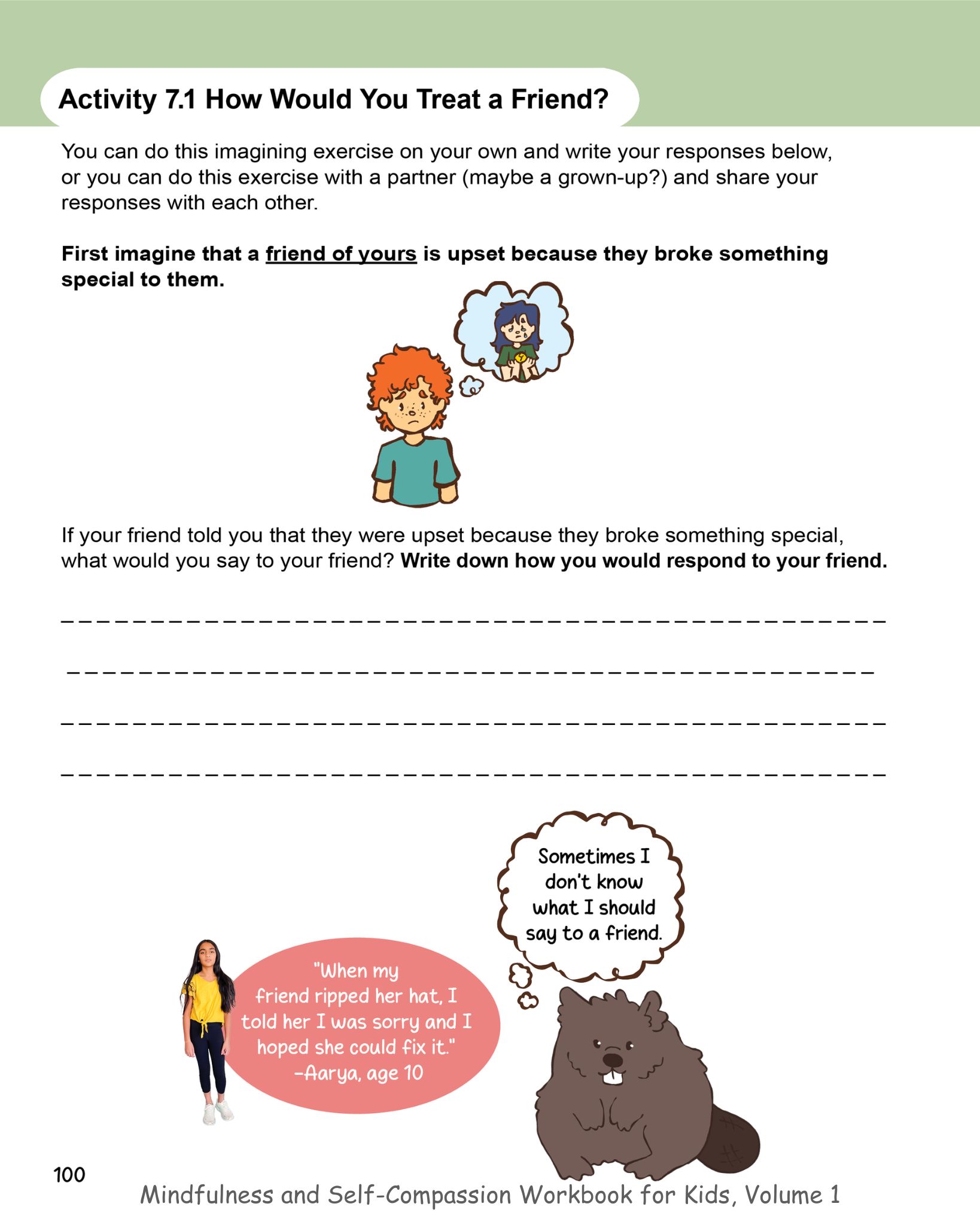
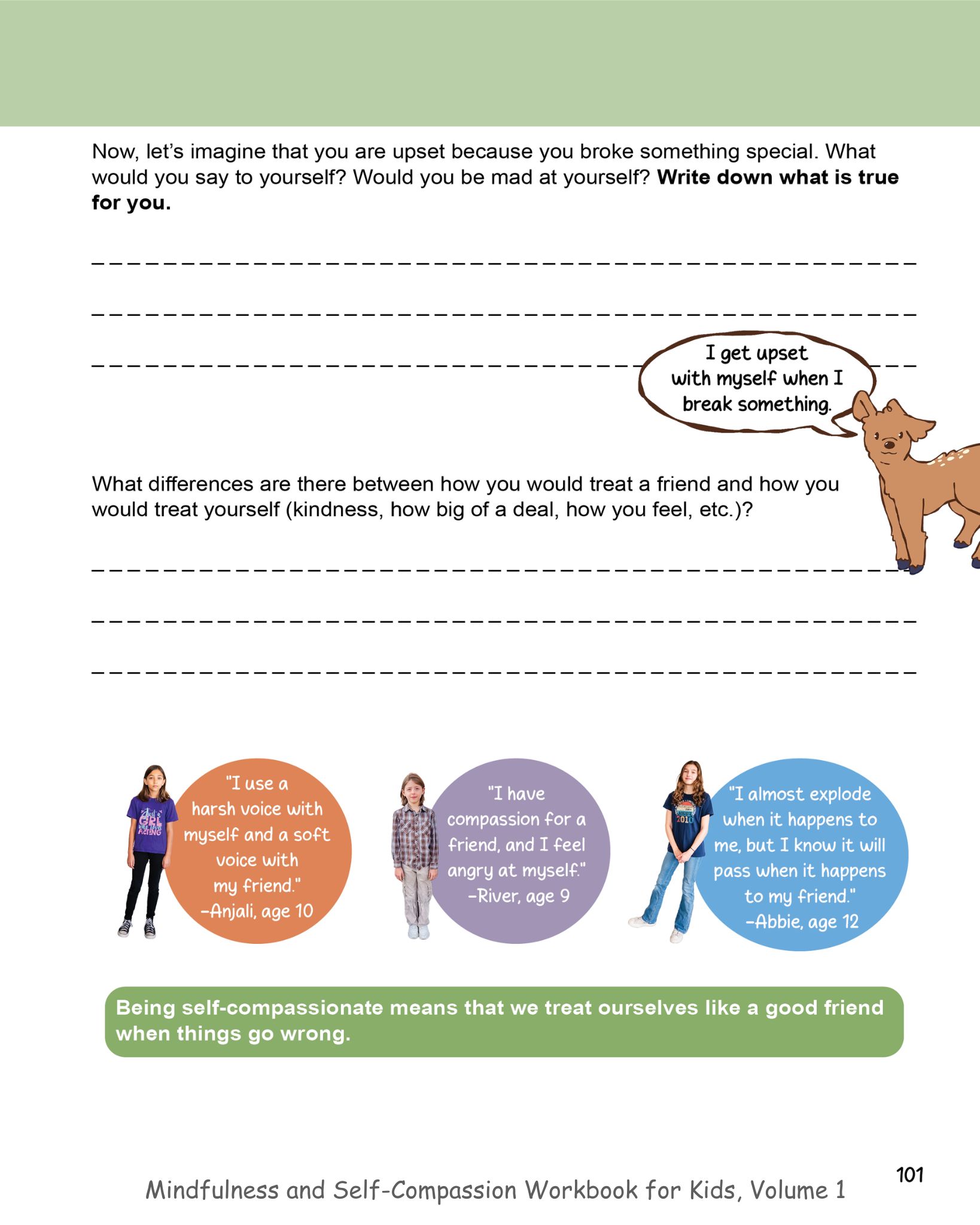
One thing I’ve learned from doing this exercise with kids is that concrete scenarios matter. Not every scenario lands, which is why the workbook moves through several rather than stopping at one. And sometimes kids aren’t sure what they would say to a friend. That’s okay too. Kids can grow kindness toward themselves and kindness toward others side by side.
Recently, I was working with a boy who tends to get hard on himself when he makes mistakes. We had just done the How Would You Treat a Friend exercise together, and then had moved on to considering what he would say to a friend who was worried about doing poorly on a test. The boy thought about it, and then said quietly, “It is okay to do mistakes.”
Later that day, when he got frustrated with himself for making an error, I reminded him of his own words. It landed differently than anything I could have said because he was hearing his words. That’s the power of this exercise.
When kids hear their own words, something shifts.
It can also be helpful to have kids consider the words they’d like to hear when things go wrong. Here is a playful exercise with Super Snuggles, the resilience habit animal who helps kids develop a kind inner voice..
Self-compassion doesn’t always come easily. A handful of years ago, I recorded my daughter Anjali and me doing the How Would You Treat a Friend exercise together. You’ll hear some resistance from her in the video when I ask her to say kind words to herself. We can normalize that it takes time to get used to a kind inner voice.
You can also try this with your kids in real time. When you hear them being hard on themselves, you can casually ask, ‘What would you say to a friend who did that?’ You don’t have to announce it as an exercise. I sometimes do this with my teenagers when I hear them struggling with inner criticism or self-doubt.
And the next time you’re having a difficult time, you can try it with yourself too. Ask yourself what you would say to a friend. Then try saying those words to yourself.
Wishing you the kindness you would offer a friend,
Jamie Lynn
P.S. If you’d like regular reminders about how to help kids and you grow self-compassion, you can join my newsletter community here.