
Whenever I read about a mindfulness-in-schools study that didn’t have the results researchers were hoping for, my heart sinks a little. I feel a mix of disappointment and confusion because I know mindfulness can be helpful, and we all want to support kids who are struggling.
But after a little reflection, I remind myself of a few important things.
- Mindfulness is not the same as self-compassion, especially when we’re trying to support kids with big feelings. Non-judgmental awareness is a building block, but if it’s not paired with kindness, children will lack the care they need to stay with what they’re experiencing.
- Regulation happens in relationships. Children don’t learn to calm themselves in isolation. They learn it through repeated experiences with an attuned adult who can stay present with them when things feel hard.
- The caregiver’s mindfulness and self-compassion practice has to come first. We can’t help kids grow something we don’t embody.
If you’d like to read more about the mindfulness-in-schools research that sparked this reflection, you can read this article by Drs. Richie Davidson and Cortland Dahl. They remind us how a caregiver’s personal practice shapes the well-being of their students.
This is why the first three steps in my framework for teaching kids self-compassion center on caregiver well-being:
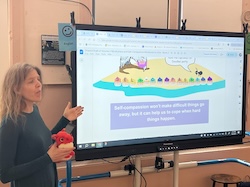
The Framework: Four steps in sequence
Steps 1-3: Build the relational foundation
Before we teach children self-compassion, we build the ground they stand on. These first three steps happen in relationship, not in curriculum.
Step 1: Caregivers and educators learn self-compassion themselves. We cannot help children grow a skill we do not practice. Whether you are a parent, teacher, or clinician, this is the starting point.
Step 2: Model self-compassion out loud. Children internalize what they observe. When an adult names their own struggle and responds with encouragement or tenderness out loud in front of a child, they make self-compassion visible.
Step 3: Become the external compassionate voice. Children absorb tone before technique. The way we speak to them shapes how they eventually speak to themselves. Over time, the compassionate voice they hear from us helps build a self-compassionate inner voice.
These three steps are relational. They unfold in everyday moments of modeling and attunement. But modeling alone is not enough. Children also need structured opportunities to recognize their patterns and practice new responses.
That is where Step 4 comes in.
Step 4: Explicitly Teach and Scaffold Self-Compassion
Self-compassion becomes teachable when it is playful, speaks the language of children, and is introduced through engaging lessons. Step 4 is where structured teaching begins.
You can read the full framework on my here →
I know how easy it is to read something like this and immediately think about the kids in your life… what they need and what you wish you could help them with. This desire to help our kids comes from a beautiful place, and it is important (it’s why I’ve created my classes and workbooks for kids).
But again and again, I’ve seen that the most meaningful shifts for children begin when the adults around them take time and space to tend to their own inner experience. When we learn to meet ourselves with kindness, it changes how we show up for our kids.
If you’re ready to build that foundation, I offer the 8-week Mindful Self-Compassion course in a fully self-paced format—so you can begin anytime and move at a rhythm that fits your life. There’s also a 6-week version designed specifically for parents and caregivers if you’d like something more condensed. (You can explore both MSC offerings here).
If you’re not quite ready for a course, I’d love to stay connected. Join my newsletter for practical tools and reflections to help you and the kids you care about grow self-compassion.
Wishing you the gift of your own kindness,
Jamie Lynn
P.S. If you’re looking for a way to support your child with big feelings, my free mini-course might be a helpful next step. It offers simple, playful ways to help children grow self-compassion when life feels hard. You can find it here.