
Teaching Kids Self-Compassion: A Relational 4-Step Framework
Children do not learn self-compassion because we tell them to “be kind to yourself.” They learn it because they experience it, again and again, in relationship.
Over the past decade, I have taught mindfulness and self-compassion in elementary classrooms, trained preservice and inservice educators, and worked alongside hundreds of families in my parent-child Mindfulness and Self-Compassion for Children and Caregivers (MSC-CC) program. MSC-CC is a research-based adaptation of Kristin Neff and Chris Germer’s Mindful Self-Compassion program, and multiple peer-reviewed studies have examined the program and its outcomes.
What I have seen in schools and in homes is that children develop self-compassion relationally as they learn and practice it over time. There is a framework that works. Within it, every child’s practice looks a little different, because the essential self-compassion question is, What do I need right now?
This article explains the Relational 4-Step Framework and shows how the playful, animal-based language and activities from the Mindfulness and Self-Compassion Workbooks for Kids make self-compassion both teachable and meaningful for kids.
The Framework: Four Interconnected Steps
Steps 1-3: Build the Relational Foundation
Before we teach children self-compassion, we build the ground they stand on. These first three steps happen in relationship, not in curriculum.
Step 1: Caregivers and educators learn and practice self-compassion. Whether you are a parent, teacher, or clinician, growing your own practice is essential. This can begin alongside the children in your life or on your own. We cannot help children grow a skill we do not practice.
Step 2: Model self-compassion out loud. Children internalize what they observe. When an adult names their own struggle and responds with encouragement or tenderness out loud in front of a child, they make self-compassion visible. Modeling normalizes both struggle and self-kindness.
Step 3: Become the external compassionate voice. Children absorb tone before technique. The way we speak to them shapes how they eventually speak to themselves. Over time, the compassionate voice they hear from us helps build a self-compassionate inner voice.
These three steps are relational. (Read more details about steps 1-3 here.) They unfold in everyday moments of modeling and attunement. But modeling alone is not enough. Children also need structured opportunities to recognize their patterns and practice new responses.
That is where Step 4 comes in.
Step 4: Explicitly Teach and Scaffold Self-Compassion
While the first three steps build the relational foundation, Step 4 provides the structured scaffolding children need to move from experiencing compassion through an adult to practicing it for themselves.
Both the MSC-CC program and the workbooks that grew from it are built around a simple idea: self-compassion becomes teachable when it is playful, concrete, and speaks the language of children. Comics, animals, activities, and shared metaphors give abstract skills a face and a name, making self-compassion accessible, memorable, and transferable to real moments. Add an adventure map and a celebration, and kids have a reason to keep coming back.
How Step 4 Comes to Life: Animals, Shared Language, and Adventure
In Step 4, self-compassion becomes something children can see, touch, and imagine. A plate and colored crayons teach children to create space for a full range of emotions. Eli the Elephant, paired with a small blanket, teaches children about resistance and how we can wrap difficult emotions in compassion. These tangible, playful metaphors create a bridge into a child’s inner world without triggering overwhelm.
Step 4 introduces two interconnected animal systems, each helping children answer one essential question. This shared language makes self-compassion memorable and transferable to the playground, the classroom, and home.
Feelings Habit Animals: Helping Children Notice
The first task in teaching self-compassion is helping children recognize how they respond when things go wrong. Talking directly about “feelings” can sometimes trigger eye rolls or shame. The Feelings Habit Animals create a safer entry point.

There are five Feelings Habit Animals:
- Beaver – sticky thoughts that replay over and over
- Bear – big feelings that overwhelm
- Chameleon – hiding from or distracting away from emotions
- Deer – shame or self-blame about having feelings
- Dragon – a mix of different patterns
Children take a short quiz and discover their animal. This does two important things. First, it creates cognitive distance. For example, a child can say “I have the beaver habit” instead of “I am an anxious kid.” Second, it communicates common humanity: other children have these patterns too.
This reduction in shame is not accidental. It is the foundation for growth.
Take the Feelings Habit Animal Quiz
Resilience Habit Animals: Helping Children Respond
Noticing a pattern is only half the process. Children also need to know what to practice when they notice it. While the Feelings Habit Animals help children answer, What tends to happen inside me?, the Resilience Habit Animals answer the essential question: What can I do now?

There are five Resilience Habit Animals:
- Spots the giraffe – noticing feelings, body sensations, and the present moment (Mindfulness)
- Buddy the dog – remembering you are not alone (Common Humanity)
- Snuggles the bunny – offering comfort and encouragement (Self-Kindness)
- Doodles the dolphin – taking helpful action
- Sunny – noticing the good alongside the hard
Together, the Feelings and Resilience Habit animals create a Notice and Respond rhythm that makes self-compassion concrete and repeatable.
Self-compassion is not a one-size-fits-all response. Different children need different things in different moments. One child may need to remember they are not alone (Buddy), while another may need to move their body (Doodles). The Resilience Habit Animals help children discover what might help in the moment. Over time children begin to ask the question for themselves: What do I need right now?
Kids discover their preferred resilience habit animals through a quiz and then practice strengthening their habits through playful practice.
Take the Resilience Habit Animal Quiz
Children may have little interest in doing a “self-compassion practice,” but they are very interested in doing an animal practice. Once the animals become familiar, a teacher or parent can simply ask, “Do you need Spots or Snuggles?” The animals become a shared language that families and classrooms can use in real moments and often become part of how children respond to their own experiences.
The Resilience Habit Animal Stories help introduce and build this shared language through read-alouds, videos, and role play. The Mindfulness and Self-Compassion Workbooks for Kids help kids deepen the habits through lessons, comics, and activities that help them recognize their patterns and practice new responses.
Explore the Mindfulness and Self-Compassion Workbooks for Kids
Making Learning Fun: An Adventure Map
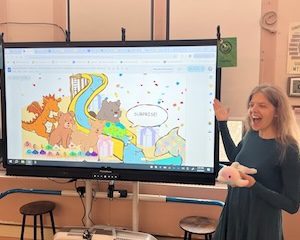
The animals draw kids in, and the adventure map keeps them coming back. In my programs and workbooks for kids, children follow a quest map across three regions, each corresponding to a developmental phase of learning self-compassion:
Foundation Forest builds the foundational ingredients: emotional awareness, mindfulness, and the understanding that struggle is part of being human.
Sweet Meadow adds the sweeteners: kindness, compassion, gratitude, and taking in the good.
Magic Mountains applies the skills where it matters most: in moments of anger, self-criticism, and difficulty.
This progression is not arbitrary. Kindness cannot take root without awareness and belonging. Learning the foundations comes before application because children need the habits before they can use them under pressure.
Every journey ends in the same place: Celebration. Children know from the beginning where they are headed. That destination is intentional because growth deserves to be celebrated!
Shared Experience and Choice
Self-compassion grows in connection.
In the MSC-CC parent-child program, parents share their own experiences, not as experts, but as co-learners. When a parent or other caregiver says “I have the deer habit sometimes too,” they create a bridge. Children begin to see that struggle is not something that belongs only to them.
In the workbooks, real kids share their thoughts and experiences throughout the comics and activities. Children recognize themselves in those stories before they are ever asked to speak.
This sharing is not incidental. It reduces shame and increases safety. Children are always given a choice, and they are never required to share. Vulnerability is modeled, and safety is maintained. Self-compassion grows in that space between honesty and choice.
Why the Relational Foundation Matters
Step 4 is powerful, but it does not work in isolation.
If a child is told to “be kind to yourself” without having experienced kindness from the adults around them, they may resist or feel confused. That is not a failure of the child. It is a signal to return to the foundation.
When resistance shows up, the most effective response is not to push harder on the technique. It is to strengthen adult self-compassion, keep modeling, and use a compassionate voice as consistently as we can (and give ourselves compassion when we fall short).
It is important to practice playfully when children are not struggling. Skills built during calm moments are far more accessible when hard moments arrive. Stories, role-play, and playful activities allow children to practice the language of compassion before they need it most.
Over time, with gentle structure and repeated invitations, the practice takes root.
Using This Framework Across Settings
This framework adapts across contexts:
In classrooms, the lessons provide short, structured experiences and shared language that normalize struggle and build kindness across a group. Comics, animals, and engaging activities create a structure that works within a single session or spread across days. The animal system gives teachers a common vocabulary that can be referenced in everyday moments between lessons.
In therapy offices, the animals and metaphors create cognitive distance and playful entry points, which can be especially helpful for children who carry shame or trauma around their emotional responses. The adventure structure gives children something to look forward to and return to across sessions.
In homes, self-compassion often grows through everyday moments of modeling and connection. Stories, conversations, role-play, and workbook activities all support practicing the habits together (many families report that workbook activities are great before bed).
Self-compassion is both relational and teachable. With modeling, structure, and repeated practice, children can learn to meet their struggles with kindness and strength.
The MSC-CC program, which uses the Relational 4-Step Framework and the Resilience Habit Animals, has been examined in peer-reviewed research. Families who participated reported positive experiences and improvements in caregiver self-compassion, parenting stress, mindful parenting, and child well-being.
Explore the Framework
- Take the Feelings Habit Animal Quiz
- Explore the Mindfulness and Self-Compassion Workbooks for Kids
- Try the free mini-course on helping kids with big feelings
- Learn about educator trainings
Would you like resources, lesson ideas, and new content delivered to your inbox? Join the newsletter.