
Recently, my 8th grade daughter had volleyball tryouts. Although she has bumped a volleyball back and forth during PE class, she’s never actually had formal volleyball training. Nonetheless, she went to all three days of tryouts and gave it her best effort.
On Wednesday night, she came home and said that they would email the list of kids who made the team by 9:00 p.m. We waited. At 9:00 p.m. there was no email. 9:05, no email. 9:10, 9:20…still no email. A little after 9:20 she received some messages in a group chat about kids who had made the team and kids who had not made the team. Anjali was on the list of kids who had not made the team.
When kids don’t make the team, get a low grade, or fall short of a goal, what meets them next often shapes their confidence far more than the setback itself.
That night Anjali had some sad feelings, and I hugged her. Her disappointment was real, and I felt it with her. The next day after school we talked about the volleyball tryouts a little more. I told her I was proud of her for trying her best even though she’s new to the sport. That’s when she looked at me and said, “I’m proud of myself too.”
Those words filled my heart with joy. Here was a child who had tried and failed to make the team, and she appreciated her own effort.
After Adversity: Self-Criticism or Self-Compassion?
After adversity, kids are often met with either self-criticism or self-compassion (and it’s frequently self-criticism). The voice that meets them in hard moments makes all the difference. This time Anjali was met with the voice of self-compassion.
Something we talk about a lot in our family, and that I teach in my work with kids, is that we all have strengths and struggles. This is part of being human. When we forget this truth, perfectionism and the inner critic can surface. When we remember this truth, we can love ourselves and keep trying.
The comic below is from Volume 2 of the Mindfulness and Self-Compassion Workbook for Kids, in the land of self-acceptance.
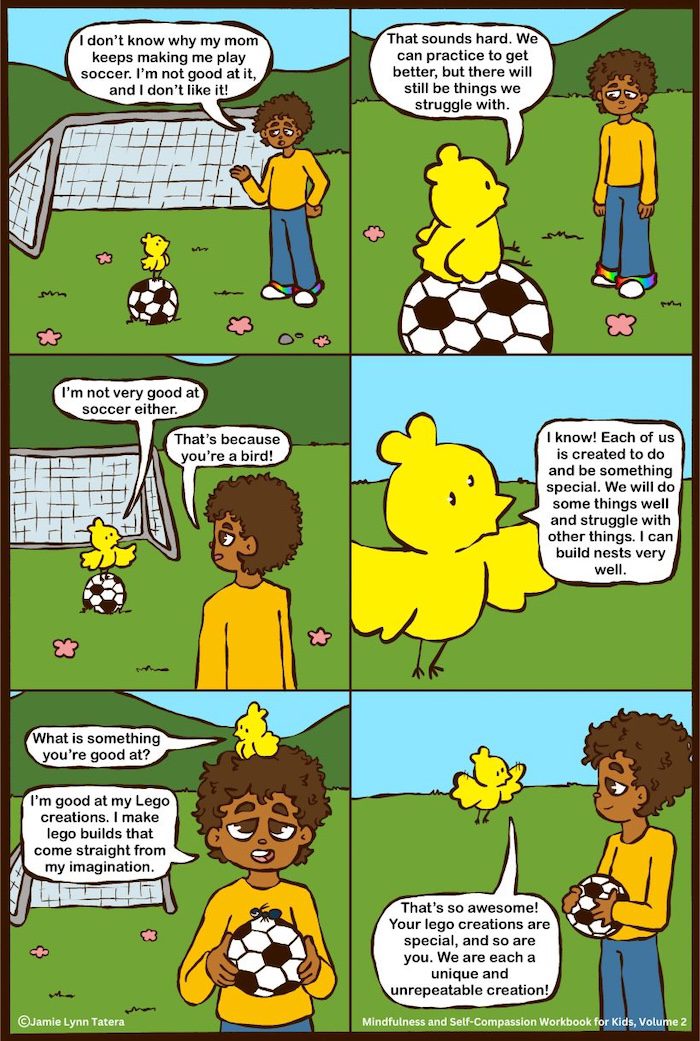
In the above comic, Sam was being forced to play soccer even though soccer was not Sam’s strength or interest. For Sam, focusing on other interests and accepting that soccer was not a good match was the right choice.
This was not the case for Anjali. A few days after we found out that she didn’t make the team, we discussed what she was going to do over the next few months for physical exercise. I asked her if she wanted to take some classes to improve her volleyball skills. Was it really a sport that she was interested in? She said it was, and we are signing her up for some classes that will help her build volleyball skills.
What helped Anjali have the courage to get up and try again? It’s self-acceptance and self-compassion. She understands that everybody struggles. She also understands that we can grow skills and learn things we want to improve at. She is growing a supportive inner voice that will help her learn new skills.
With love and appreciation,
Jamie Lynn
P.S. Here are a some activities from Volume 2 of the Mindfulness and Self-Compassion Workbook for Kids that can help your child grow a kinder inner voice:
If you’d like regular reminders about how to help kids (and yourself) grow self-compassion, you can join my newsletter community.