How Can We Support Diversity?

Supporting Neurodivergent and Racially Diverse Children with Self-Compassion

Hello friends,

I am passionate about self-compassion for youth because it can help children and caregivers suffer less. Suffering can have many sources, including life events, our internal experiences, and external oppression. Today I’d like to unpack the topic of suffering as it relates to diversity and self-compassion. And in next week’s newsletter, I will share more about what we can DO to help.

Supporting Children with Neurodiversity

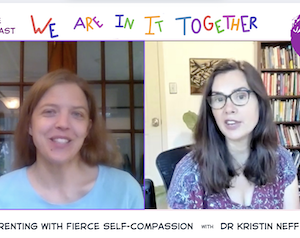
My colleague Kate Lynch is the mom of a neurodiverse child, author, and the host of the Atypical Kids, Mindful Parents Podcast. Kate and I had a phenomenal conversation about how self-compassion can help us to raise neurodivergent youth with resilience. You can listen to our interview on this topic on Youtube or Apple podcasts or your favorite podcast app to discover ways to help yourself and youth with neurodiversity (including ADHD, autism, learning, and sensory differences) grow this important resource.


“You will never know what it’s like”

In next week’s newsletter, I will be addressing the topic of linguistic and racial diversity.

I was talking to a dear friend the other day who was sharing her concerns relating to anti-diversity executive orders and rhetoric propagated by our current administration. “I understand,” I said to my friend.

“No you don’t,” she responded. “You will never understand. You will never know what it is like to be a woman of color living through this.”

I paused to soak in the truth of her words. “You are right.” I responded. And I listened.

Cultural Humility

It is with deep humility that I write this blog and share next week’s podcast episode on diversity and self-compassion. As a female, I have been on the receiving end of sexism (see my podcast episode on countering gender stereotypes), but I do not know what it is like to live with racial and linguistic discrimination. So I listen, I learn, and I care deeply.

Attending a small Catholic K-8 school in Green Bay, my early years were devoid of the enrichment of diversity. My horizons broadened somewhat when I went to high school, and they broadened even further when I went to college. It’s in college that I truly learned the value of diversity, including linguistic and ethnic diversity. I will share more about this journey next week.

In college I also took classes on anti-racism. This is where I learned to see many of my own unconscious biases. And this is why I try to follow the lead of individuals from diverse groups when it comes to justice movements.

Diversity in My Work with Kids

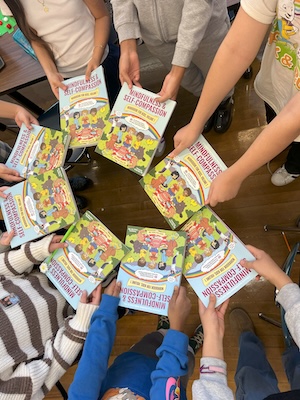
I frequently teach in Milwaukee Public Schools with children of diverse backgrounds, and when I created the Mindfulness and Self-Compassion Workbook for Kids, Volumes 1 & 2, I was intentional about including diverse voices.

I asked children from diverse backgrounds to help me create and edit the book, which made my book richer for everyone!

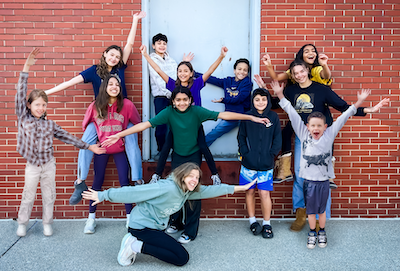
Here’s a picture of the kids who helped to shape and share their personal experiences in the book:

Jamie-Lynn with kids who helped to shape and share their personal experiences in the book:  Mindfulness and Self-Compassion Workbook for Kids, Volumes 1 & 2.

And here are the delightful characters that appear in the comics:

Delightful characters from the book: Mindfulness and Self-Compassion Workbook for Kids, Volumes 1 & 2.

I tried to incorporate racial diversity, gender diversity, and a diversity of feeling and thinking habits into my characters so that as many children as possible could see their own experience reflected in the book (see this article on feelings habits). I wish for all children to see and sense that self-compassion is for them!

What we can DO

Something I love about my community of readers is that we are all deeply committed to helping children suffer less through the power of self-compassion. Next week, I will unpack more about about how self-compassion can help us respond to diversity-related oppression, and also what we can ALL do to help. I can barely wait!

Thank you for being on team compassion and self-compassion with me, especially for the most vulnerable of our youth.

Wishing you light and love,

Jamie Lynn

P.S. Last weekend I got to go up North and spend time with my family. This was special for two reasons:

  1. My older daughter drove the car (her first long car trip driving!)
  2. I got to see my sisters and parents. I love my family!
Maya - Jamie-Lynn's oldest daughter driving.
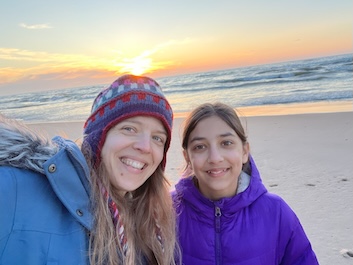
Jamie-Lynn with her two sisters and mom.

Popular posts from previous weeks:

Mindfulness as a Resource

Sometimes we really need something to pull us back to the Present Moment

Hello Friends,

Have any of you found yourself flooded with difficult thoughts and feelings lately? If so, you are not alone. Many of us are going through hard times, and self-compassion is a resource that can hold us as we go through it.

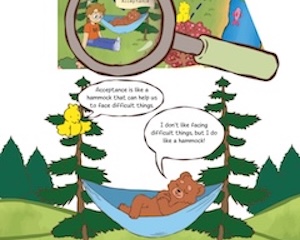
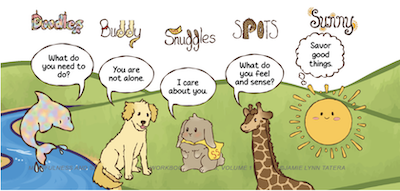
When I’m struggling, often I need the kindness aspect of self-compassion, which I like to call “Snuggles” the bunny. Additionally, I need connection, which I call the “Buddy” habit. Connection for me might look like talking to a friend or spending time in nature. Moving my body (the “Doodles” Habit) and noticing small ways I have well-being (“Sunny”) are two other helpful habits. But today, I’m going to highlight the resource of Mindfulness, which I refer to as “Spots.”

The 5 resilience habit animals from my Workbooks for Kids and my Parent-Child class.

Note: These are the 5 resilience habit animals from my Workbooks for Kids and my Parent-Child class.

What is Mindfulness (aka the “Spots Habit”)?

In a nutshell, mindfulness is the ability to be present in the moment without judgment. As we are creatures of judgment, we can be mindful of our judgments, too. People often describe mindfulness as being calm, which is a bit of a misnomer (see my Mindfulness is Not About Being Calm blog). While mindfulness does make us calmer over time, we can be mindful of anxiety, anger, racing thoughts, body sensations, etc. We can be mindful of anything!

How do we practice Mindfulness in the moment?

A great way to practice mindfulness is to ground your awareness in your five senses. The mind will wander, and then you again bring your awareness back to the moment. You can pick any internal or external sense to notice, including the rhythm of your breath, your sense of sound, or your sense of sight.

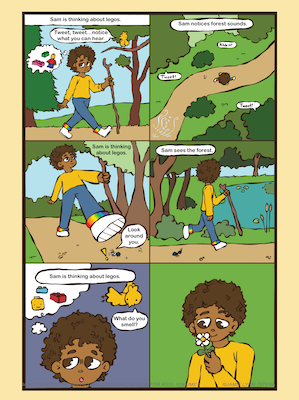
Here I’d like to share a playful comic from the Mindfulness and Self-Compassion Workbook for Kids, Volume 1. Sam is a character that often gets lost in thoughts (can anyone relate?), and one of Sam’s favorite things to think about is Legos. Notice how Sam is invited again and again to focus on the present moment.

A comin character - Sam who always gets lost in thoughts.

You can try this next time you go for a walk. Notice when your mind wanders, and then bring yourself back to your senses!

Taking a class can help both you and your child grow mindfulness and self-compassion skills. Join me in April for our next Parent-Child Mindfulness and Self-Compassion class!

Join me at a Mindfulness & Self-Compassion gathering

Each month my paid subscribers can join me for a gathering where we together grow our OWN mindfulness and self-compassion skills. Growing mindfulness and self-compassion skills in playful ways can help us to…
  1. Feel better in our own skin.
  2. Show up in better ways for our kids.
  3. Develop the skills and insights to effectively help our kids grow these skills.

Learn more

Please share with me in the comments how you like to practice mindfulness in daily life. And as always, thank you for being on this journey with me.

Warmly,

Jamie Lynn

Nurturing Self-Compassion in Children (and Ourselves!)

Simple steps to help kids grow a kind inner voice

Hello Friends!

I’d like to reintroduce myself and welcome new friends to my blog. If you signed up for my workshop with Kristin Neff’s Community, you are in the right place (and if you didn’t you’re still in the right place ;)! I’m Jamie Lynn Tatera—educator, parent, and Mindfulness and Self-Compassion for Children and Caregivers (MSC-CC) teacher and teacher trainer. I have a passion for helping kids and their caregivers grow the resource of self-compassion to support their mental and emotional well-being.


    Jamie-Lynn with her daughters.

    My newsletter features excerpts from my Mindfulness and Self-Compassion Workbook for Kids, as well as wonderful tips for helping children and their caregivers grow their mindfulness and self-compassion skills.

    Next week, I’ll be sharing some exercises from the third adventure of my workbook for kids in the Land of Mindfulness. We’ll be exploring fun ways to help kids get curious about mindfulness skills and train their “puppy dog” minds.

    Today, I’d like to share an article that I wrote for the Global Compassion Coalition(GCC) on how to help children grow the resource of self-compassion. I hope you enjoy!

    Nurturing Self-Compassion in Children (and Ourselves!)

    In the wake of recent US legislation, it’s vital that we help children, especially children from marginalized groups, know their own value. Self-compassion is one of the best tools I know for helping kids understand that they matter, and empowering kids to believe in themselves.

    A simple definition of self-compassion is to treat ourselves as we would treat a good friend. This means that we comfort ourselves during our difficult moments, and we encourage ourselves to grow and change in positive ways. But just how do we help children develop this important skill? We can do this in several ways, including offering children our compassionate and loving presence, modeling self-compassion, and playfully teaching kids self-compassion.

    Be the voice you want children to internalize

    The way that we treat children matters. The words that we use with children can become a part of their own internal voice. When we tell a child they are valuable, and show them through our active listening and attunement, children internalize the belief that they matter. When we are able to balance holding high standards for children with acceptance and understanding of their struggles, children grow this same capacity within themselves. External affirming words and supportive actions become internalized and are a part of how children learn to respond compassionately to themselves.

    JL Note: When we fall short of this aspiration, we can give ourselves self-compassion and begin again. Our shortcomings offer us the opportunity to do the next step…

    Model self-compassion in the presence of children

    Caregivers can also model self-compassion to children. Every time a caregiver falls short or struggles in the presence of a child, we can also model self-compassion. If we have made a mistake, we can model both owning our mistake and also reminding ourselves that everyone falls short sometimes. If we are struggling, we can name out loud that it’s human to struggle sometimes. If we have a critical internal voice, we can normalize and name that, too. We can help children to be mindful of a critical voice, which is designed to keep us safe, and we can also model a second voice–the voice of compassion. Our compassionate voice says things like, “No one is perfect; I will try my best; I can do hard things.” Our modeling of a self-compassionate voice can help to shape a child’s own internal voice of kindness.

    Playful self-compassion instruction

    Finally, we can teach children self-compassion. I have created a Mindfulness and Self-Compassion program for Children and Caregivers (MSC-CC), which is a playful, research-based adaptation of the Mindful Self-Compassion program. I have also created the Mindfulness and Self-Compassion Workbook for Kids, which teaches children mindfulness and self-compassion skills using playful animals, characters, and the experiences of real children. Spots the giraffe teaches kids to be mindful of their thoughts, feelings and sensations, and Buddy the dog helps children realize that they are not alone in their struggles. Super Snuggles the bunny helps kids to comfort themselves when they are struggling and encourage themselves with kindness. Both the workbook and the course also feature Doodles the dolphin who helps kids take compassionate actions, as well as Sunny, who helps kids remember to take in the good.
    Animals from the workbook for kids.

    Victoria Brattini, GCC volunteer and founder of the Laguna Meditation Center, has recently been using excerpts of the Mindfulness and Self-Compassion Workbook for Kids, Volume 1, with her adult clients. Victoria shares:

    “I’ve been encouraging adults to use the workbook in a playful way for themselves. I say just read it and let yourself feel the warmth and fun there. Years ago when I was desperate to improve my French and Italian, I asked another Mom who was from Austria how she had learned English. She had only been here for a few years and her answer was children’s books, games, shows, etc. She said it’s less intimidating and you feel a sense of accomplishment. Plus they are more fun. [This] book is playful and full of humor, and for the adult who has reservations about self-compassion or even trying to name an emotion, I think this book can make the challenge a little easier for them. Yes, it’s written for kids, and there’s good wisdom there for adults too. I’ve been encouraging my clients to play, laugh…and see the humor in life. Play is essential.”

    We can all benefit from learning mindfulness and self-compassion skills through play. Playful instruction, parental modeling, and the internalization of adults’ compassionate responding can all contribute to the growth of self-compassion in children. The important thing is that we, as caregivers, are intentional about nurturing these compassionate qualities in our youth…and in ourselves!

    Greater Good's Favorite Books 2024

    Thank you for being on this journey with me!

    With love,

    Jamie Lynn

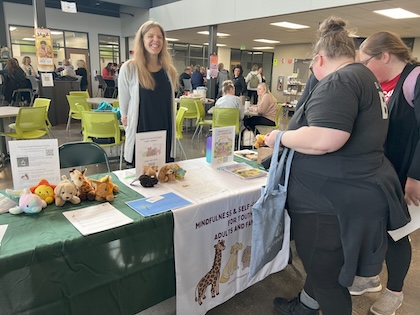
    P.S. Last week I was gifted with the opportunity to teach “resilience habits” including mindfulness and self-compassion to caregivers in the Waterford school district. Here’s a very smiley picture of me sharing about the playful animals from my program between teaching sessions.

    Jamie-Lynn at Waterford School District presenting her book with stuffed resilience animals.

    P.P.S. You can scroll down to see some popular posts from last month.

    Where Self-Compassion and Social Media Collide

    ·
    FEB 25
    Where Self-Compassion and Social Media Collide

    The other day I picked up my younger daughter from her dad’s house, and I asked her what she had been up to. She shared that she had spent the morning playing video games. She was in a delightful mood, and when I inquired about how it was for her to play video games for such a large amount of time, she said something very insightful, “I enjoyed playing …

    Unlocking our Parenting Delight

    Do you ever feel like you’ve lost your parenting delight? Or maybe you feel like you never had it!? Certified parenting educator Dajana Yoakley helps us discover tools that can put the delight back into our parenting.

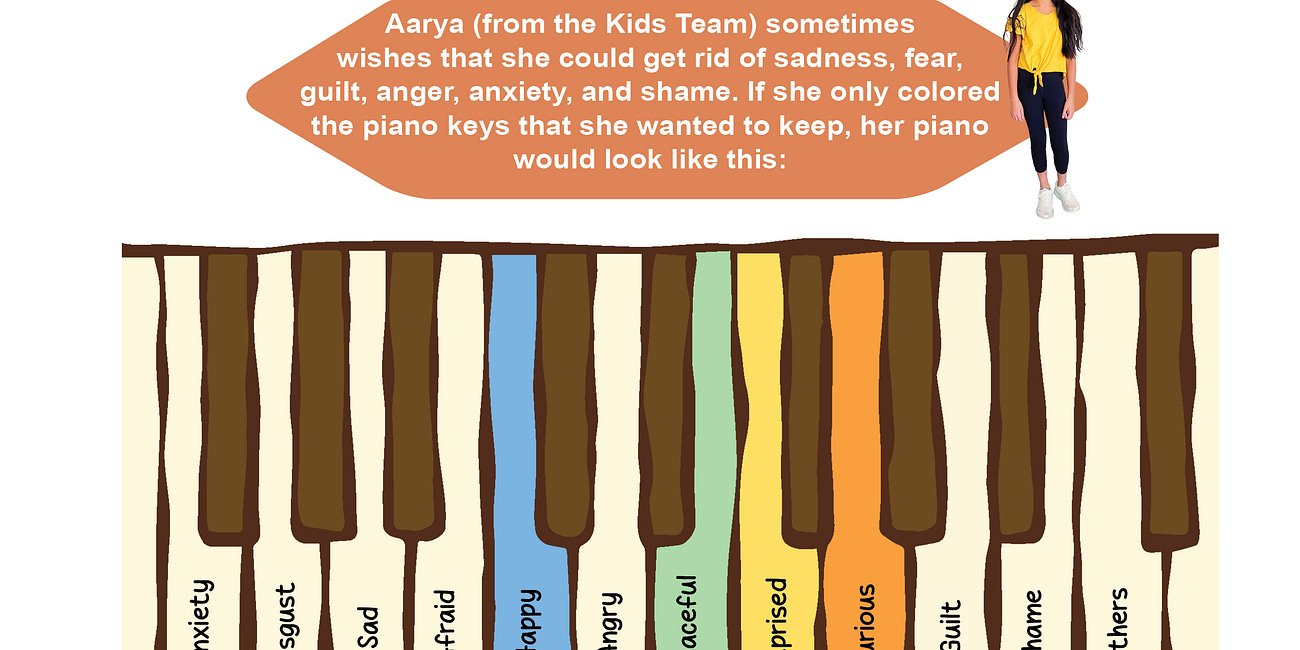
    Piano Key Feelings

    Piano Key Feelings

    Hello Friends,

    Where Self-Compassion and Social Media Collide

    Tips for helping kids (and ourselves) be mindful and self-compassionate in our technology use


    The other day I picked up my younger daughter from her dad’s house, and I asked her what she had been up to. She shared that she had spent the morning playing video games. She was in a delightful mood, and when I inquired about how it was for her to play video games for such a large amount of time, she said something very insightful, “I enjoyed playing the games because I was in a good mood before I was playing. It’s not about how much time I’m spending, but it’s about how I feel when I get on. When I’m in a bad mood, I’m thinking why did that person beat me and I get mad. When I’m in a good mood, I think, ‘Ooo…that was a really good move. I wonder how they did that.’ It’s my mental state, rather than the game, that affects how I feel after playing games.”

    How wise! I think this might be true to some degree for teens (and grown-ups) with social media use. Sometimes when I go on social media even with the best of intentions, a post or feed can trigger difficult emotions and/or lead me down a rabbit hole that leaves me feeling less well-being than when I opened the app. Other times I feel lifted up. But if I go on social media with a negative mindset, it’s almost sure to be a bad ride.

    Parents and Kids Need Support

    There is so much I can say on this topic, including the potential negative consequences and positive possibilities for the use of smartphones and social media. Much of this is covered in a panel I was part of last year on, “How to Help Kids be Smart with their Smartphones and Social Media.

    Among many things spoken about in our previous panel is that cell phones and social media are not all good or all bad. Yes, there are real social media dangers, and social media is engineered to be addictive. Nonetheless, our mind frame plays a role in how our technology use impacts us.

    In 2024, the surgeon general issued a number of warnings that relate to this conversation. One of those warnings was about the adverse effects of large doses of social media use on teens. Another 2024 advisory was about parenting stress, and how caregivers need more support in their parenting. When it comes to technology and child well-being, we all need support.

    Note: If you’d like to learn more about parent-child mindfulness and self-compassion, you can sign up here for an upcoming info session.

    Mindful and Self-Compassionate Technology Use

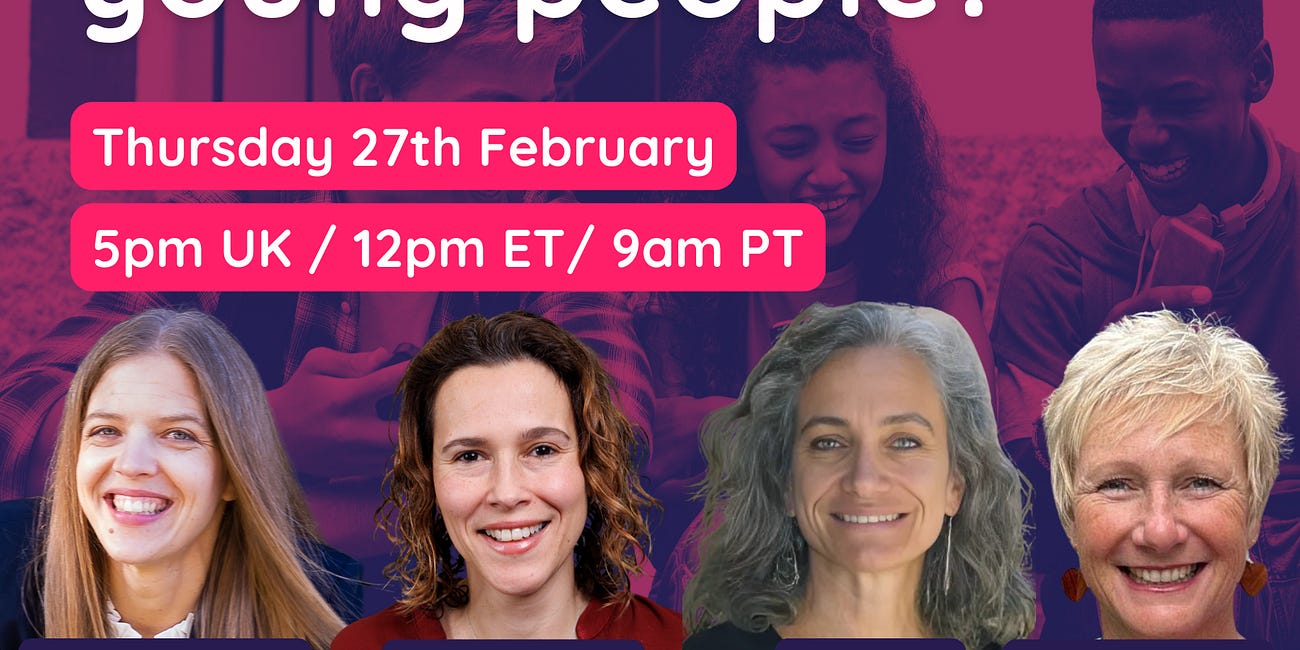
    This week I will be a part of a follow-up panel that will explore how we can help prepare children and teens to engage with technology and social media in wise ways that support their well-being. While parental controls are crucial for kids, I’m excited for a conversation about ways to help shift the burden of control off of parents. Our conversation will highlight ways that parents and kids can engage in effective dialogues to together build skills needed to self-monitor and make small shifts so that technology serves us rather than the other way around.


    It’s free to join the livestream, or you can sign up and receive the recording if you can’t join us live.

    It’s about more than just limiting technology use

    Something else that I have learned in my parenting journey is that my kids have a better relationship with their technology when their everyday lives give them what they need. When technology use is off, often it’s related to feelings of loneliness or imbalance. Instead of just focusing on limiting tech use, we can focus on enhancing areas of kids’ lives that will help them feel more balanced. I loved this article by Emily Edlynn about New Ways to Think about Parenting and Technology.

    A fun website

    If you are considering giving your kids access to social media (or they are already have access, and you’d like to increase their awareness), you and your child can together visit the website https://www.getbadnews.com/. It’s a very interactive game/program that highlights the different techniques that influencers can use to manipulate and deceive on social media. It can help kids develop critical digital literacy skills, and also establish a foundation for future conversations that parents can have with their kids when they encounter these things on social media!

    We are in this together

    This was a lot of social-media related information, and I actually had to delete a bunch of information from this post to make it fit! This topic is one I’ve struggled with as a parent, and I want other parents to know that:

    1. You are not alone in this struggle.
    2. There are resources that can help (including your own mindfulness and self-compassion).
    3. We’re in this together. We can have a strong back (technology limits) and a soft front (connecting conversations), and together we can make our own and our children’s worlds just a little more wonderful.

    With Love,

    Jamie Lynn

    P.S. One of my highlights of last week was seeing that Emily Sustar from the Motherhood Collective is using the Mindfulness and Self-Compassion Workbook for Kids with her parenting group. It made my heart warm to know that parents are using this resource to help themselves grow the skills they would like to share with their child.

    Mindfulness and Self-Compassion Workbook for Kids

    P.P.S. For just $5 a month, you can join my parenting group. Not only will you help to support my work and receive my videos with personal stories, you can also move through the workbook with others at our monthly gathering. Our next gathering is at 1 PM CT on February 11th, and we’ll be exploring the chapter of the workbook on Mindfulness. Remember, when you help yourself, you help your child.

    Unlocking Delight in Parenting

    Discover what Blocks and Facilitates Joy in Parenting

    Hello Friends,

    Are you ever hard on yourself for your shortcomings as a parent? Me, too! This is natural. But if it becomes chronic, it can really suck the delight out of parenting.

    Last week, I shared about how we can respond to our kids when they are being hard on themselves (see What to do when a kid is beating themselves up). And today, I’m excited to share with you how compassion in parenting can help us quiet the inner critic and put the Delight back into our parenting.

    Do you ever feel like you’ve lost your parenting delight? Or maybe you feel like you never had it!?

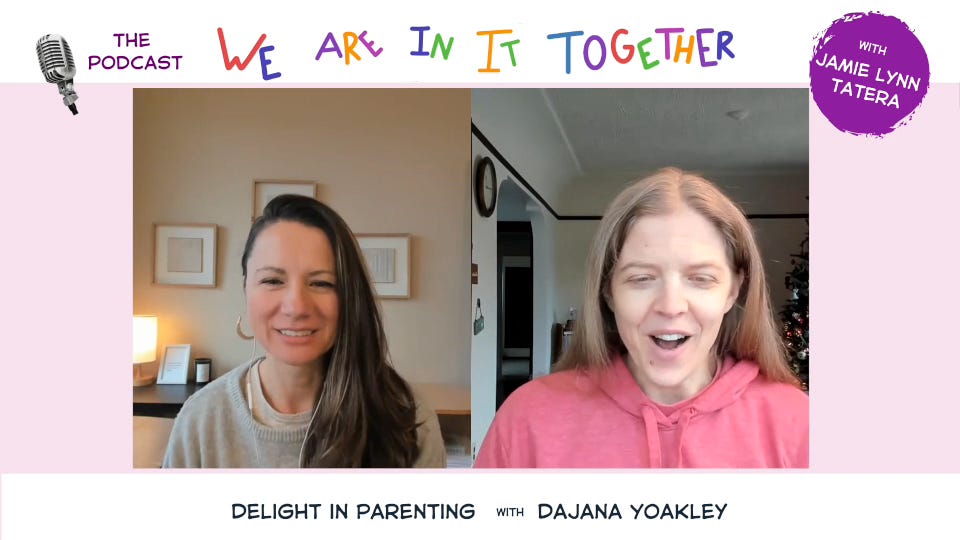
    Join Dajana and me in this episode of the We Are in It Together podcast to learn how:

    • Self-doubt robs us of parenting joy
    • Self-compassion leads to increased self-regulation
    • Understanding our child’s underlying needs can lead to increased connection
    • Accepting ourselves and our child as we are increases parenting delight
    • Emotional coaching can help children grow and change

    The right mix of understanding, connection, and guidance can put the joy back into parenting. And you deserve this goodness, my friend!

    Dajana Yoakley is a Peaceful Parenting coach, mom, and host of the Delight in Parenting Podcast. She has trained with Dr. Laura Markham and is an Aha Parenting Certified Parent Educator. She has a Masters degree in Leadership and has been trained in Playful Parenting for Parent Educators. Discover more about Dajana’s work at https://www.delightinparenting.com/.

    If you’re new to my We Are in It Together podcast, you can listen to this and other awesome episodes on your favorite podcast app.

    Reminder: Today (2/18) is the last day to get my eBook for 88% off (my Valentine’s gift for you). And you can email a picture of your book to me at jlt@jamielynntatera.com to receive my personal videos and monthly gathering one month free!

    Thank you for being on this journey with me!

    With love,

    Jamie Lynn

    P.S. It has been really, really cold here lately. Below is a picture of me walking on the beach last week when it was warm (32 degrees Fahrenheit). But when I was at the beach last night (2 degrees), the whole shoreline was frozen over!

    Jamie-Lynn at the frozen Lake Michigan