Where Self-Compassion and Social Media Collide

Tips for helping kids (and ourselves) be mindful and self-compassionate in our technology use


The other day I picked up my younger daughter from her dad’s house, and I asked her what she had been up to. She shared that she had spent the morning playing video games. She was in a delightful mood, and when I inquired about how it was for her to play video games for such a large amount of time, she said something very insightful, “I enjoyed playing the games because I was in a good mood before I was playing. It’s not about how much time I’m spending, but it’s about how I feel when I get on. When I’m in a bad mood, I’m thinking why did that person beat me and I get mad. When I’m in a good mood, I think, ‘Ooo…that was a really good move. I wonder how they did that.’ It’s my mental state, rather than the game, that affects how I feel after playing games.”

How wise! I think this might be true to some degree for teens (and grown-ups) with social media use. Sometimes when I go on social media even with the best of intentions, a post or feed can trigger difficult emotions and/or lead me down a rabbit hole that leaves me feeling less well-being than when I opened the app. Other times I feel lifted up. But if I go on social media with a negative mindset, it’s almost sure to be a bad ride.

Parents and Kids Need Support

There is so much I can say on this topic, including the potential negative consequences and positive possibilities for the use of smartphones and social media. Much of this is covered in a panel I was part of last year on, “How to Help Kids be Smart with their Smartphones and Social Media.

Among many things spoken about in our previous panel is that cell phones and social media are not all good or all bad. Yes, there are real social media dangers, and social media is engineered to be addictive. Nonetheless, our mind frame plays a role in how our technology use impacts us.

In 2024, the surgeon general issued a number of warnings that relate to this conversation. One of those warnings was about the adverse effects of large doses of social media use on teens. Another 2024 advisory was about parenting stress, and how caregivers need more support in their parenting. When it comes to technology and child well-being, we all need support.

Note: If you’d like to learn more about parent-child mindfulness and self-compassion, you can sign up here for an upcoming info session.

Mindful and Self-Compassionate Technology Use

This week I will be a part of a follow-up panel that will explore how we can help prepare children and teens to engage with technology and social media in wise ways that support their well-being. While parental controls are crucial for kids, I’m excited for a conversation about ways to help shift the burden of control off of parents. Our conversation will highlight ways that parents and kids can engage in effective dialogues to together build skills needed to self-monitor and make small shifts so that technology serves us rather than the other way around.
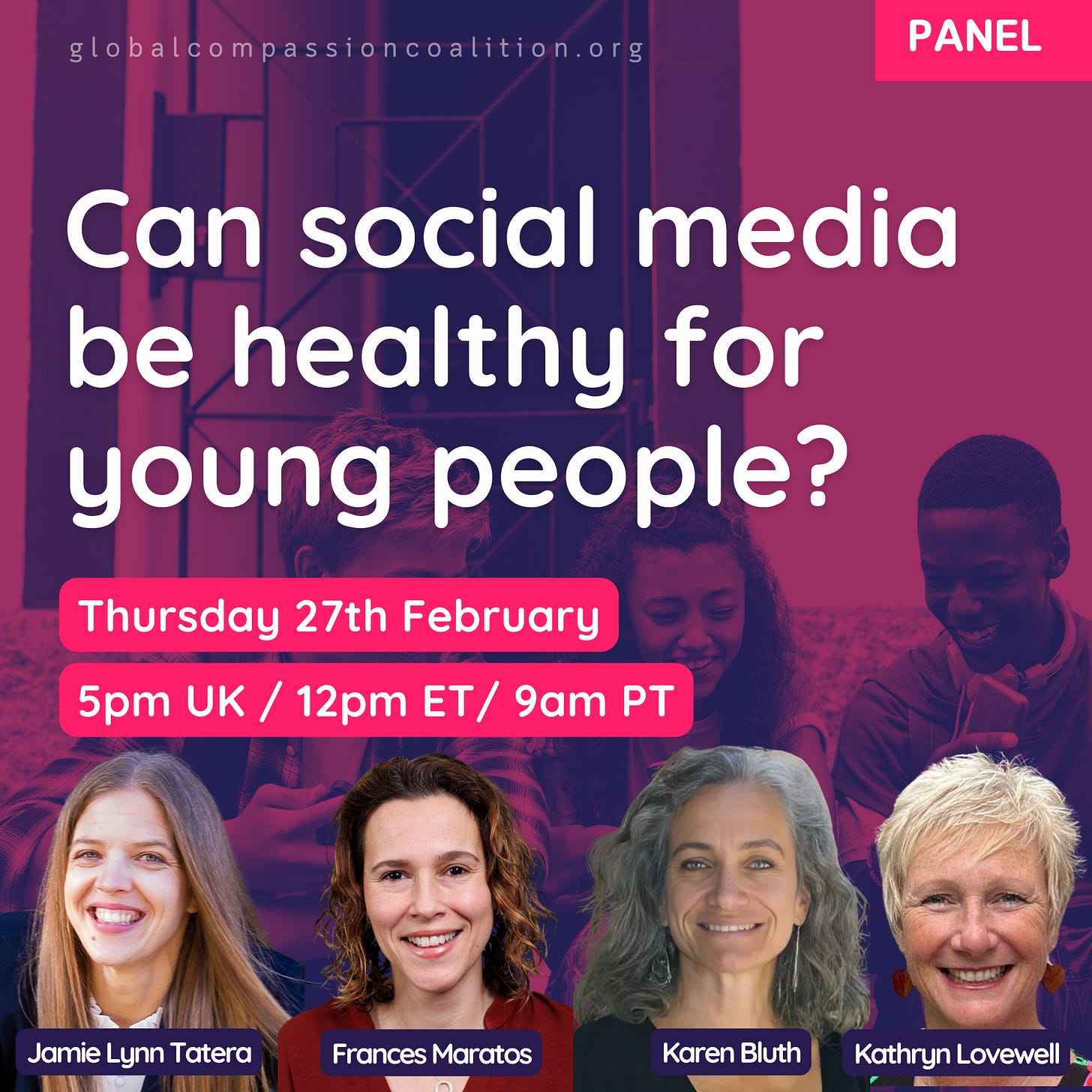
 

It’s free to join the livestream, or you can sign up and receive the recording if you can’t join us live.

It’s about more than just limiting technology use

Something else that I have learned in my parenting journey is that my kids have a better relationship with their technology when their everyday lives give them what they need. When technology use is off, often it’s related to feelings of loneliness or imbalance. Instead of just focusing on limiting tech use, we can focus on enhancing areas of kids’ lives that will help them feel more balanced. I loved this article by Emily Edlynn about New Ways to Think about Parenting and Technology.

A fun website

If you are considering giving your kids access to social media (or they are already have access, and you’d like to increase their awareness), you and your child can together visit the website https://www.getbadnews.com/. It’s a very interactive game/program that highlights the different techniques that influencers can use to manipulate and deceive on social media. It can help kids develop critical digital literacy skills, and also establish a foundation for future conversations that parents can have with their kids when they encounter these things on social media!

We are in this together

This was a lot of social-media related information, and I actually had to delete a bunch of information from this post to make it fit! This topic is one I’ve struggled with as a parent, and I want other parents to know that:

  1. You are not alone in this struggle.
  2. There are resources that can help (including your own mindfulness and self-compassion).
  3. We’re in this together. We can have a strong back (technology limits) and a soft front (connecting conversations), and together we can make our own and our children’s worlds just a little more wonderful.

With Love,

Jamie Lynn

P.S. One of my highlights of last week was seeing that Emily Sustar from the Motherhood Collective is using the Mindfulness and Self-Compassion Workbook for Kids with her parenting group. It made my heart warm to know that parents are using this resource to help themselves grow the skills they would like to share with their child.
Mindfulness and Self-Compassion Workbook for Kids

P.P.S. For just $5 a month, you can join my parenting group. Not only will you help to support my work and receive my videos with personal stories, you can also move through the workbook with others at our monthly gathering. Our next gathering is at 1 PM CT on February 11th, and we’ll be exploring the chapter of the workbook on Mindfulness. Remember, when you help yourself, you help your child.

Unlocking Delight in Parenting

Discover what Blocks and Facilitates Joy in Parenting

Hello Friends,

Are you ever hard on yourself for your shortcomings as a parent? Me, too! This is natural. But if it becomes chronic, it can really suck the delight out of parenting.

Last week, I shared about how we can respond to our kids when they are being hard on themselves (see What to do when a kid is beating themselves up). And today, I’m excited to share with you how compassion in parenting can help us quiet the inner critic and put the Delight back into our parenting.

Do you ever feel like you’ve lost your parenting delight? Or maybe you feel like you never had it!?

Join Dajana and me in this episode of the We Are in It Together podcast to learn how:

  • Self-doubt robs us of parenting joy
  • Self-compassion leads to increased self-regulation
  • Understanding our child’s underlying needs can lead to increased connection
  • Accepting ourselves and our child as we are increases parenting delight
  • Emotional coaching can help children grow and change

The right mix of understanding, connection, and guidance can put the joy back into parenting. And you deserve this goodness, my friend!

Dajana Yoakley is a Peaceful Parenting coach, mom, and host of the Delight in Parenting Podcast. She has trained with Dr. Laura Markham and is an Aha Parenting Certified Parent Educator. She has a Masters degree in Leadership and has been trained in Playful Parenting for Parent Educators. Discover more about Dajana’s work at https://www.delightinparenting.com/.

If you’re new to my We Are in It Together podcast, you can listen to this and other awesome episodes on your favorite podcast app.

Reminder: Today (2/18) is the last day to get my eBook for 88% off (my Valentine’s gift for you). And you can email a picture of your book to me at jlt@jamielynntatera.com to receive my personal videos and monthly gathering one month free!

Thank you for being on this journey with me!

With love,

Jamie Lynn

P.S. It has been really, really cold here lately. Below is a picture of me walking on the beach last week when it was warm (32 degrees Fahrenheit). But when I was at the beach last night (2 degrees), the whole shoreline was frozen over!

Jamie-Lynn at the frozen Lake Michigan

Piano Key Feelings

Activity and Workshop on Teaching Kids Self-Compassion

Hello Friends,

It was wonderful to see those of you who attended my Teaching Children Self-Compassion intro session, hosted by Kristin Neff’s Community. If you missed the intro session and would like to watch the video, you can click the “watch the free preview icon” at this link. There’s a wonderful activity for kids featured in the intro session, which I will share with you in this blog. There’s also a description of my upcoming three hour workshop!

Additionally, I am offering a workshop on Parenting with Self-Compassion for Foster Adopt Minnesota on Tuesday. I have a quiet joy and gratitude in my heart that families and professionals in the foster care system will have access to this healing resource.

Piano Key Feelings

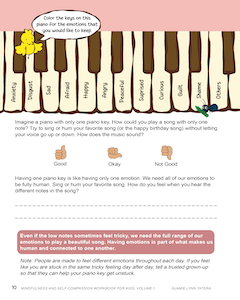
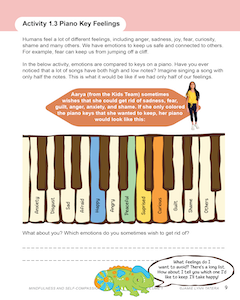
Do you ever resist difficult emotions? Me too. And so do kids. But resisting our emotions can lead to challenges over time. Kids love the “piano key” metaphor that helps them understand the value of all of their emotions. You can scroll down to the bottom of this blog to see a short video of the practice, or you can follow along these two pages from volume 1 of the Mindfulness and Self-Compassion Workbook for Kids!

This exercise does several important things:

First, it normalizes that we all sometimes resist emotions (it’s human!).

Piano Key Feelings

Second, it helps us understand the cost of resistance.

Piano Key Feelings page 2

And finally, it helps us understand the beauty of our full range of feelings.


A Bear - feeling habit animal from the workbook for kids, volume 1

Even if the low notes sometimes feel tricky, we need the full range of our emotions to play our beautiful human music. -Jamie Lynn Tatera

The piano key activity helps kids understand that all emotions belong. It is one of many playful activities featured in volume 1 of the Mindfulness and Self-Compassion Workbook for Kids. You can extend this idea with the following bonus activity:

Make an art project with emotions written on piano keys and color all the keys. Then hang it somewhere to remember that all emotions belong.

Later this month, I will share more engaging exercises for kids in a 3-hour workshop hosted by Kristin Neff’s community. You, my lovely subscribers, can receive 20% off of the How Caregivers can Nurture Self-Compassion in Children workshop that I’ll be offering on February 15th. Just use the discount code Save20%fromJamieLynnwhen you register. Click here to see the details for my workshop, which is great for caregivers who would like to experience activities and tools for helping kids grow self-compassion (and is available for CE credits!).

Register for Workshop

If you are enjoying these great resources for kids and caregivers, please share this blog with a friend and/or review my workbook (reviews and referrals make a huge difference!). Thank you for being on this journey with me.

With love,

Jamie Lynn

P.S. Here’s a short video of me demoing the Piano Keys Activity.

The Healing Power of Acceptance

Comics and Activities for Your Inner Child

Hello Friends!

I’m excited to share this article that I wrote for Rick Hanson’s Wise Brain Bulletin on the Healing Power of Acceptance. So needed!

The Healing Power of Acceptance

The comics and activities in this article are excerpted from the Mindfulness and Self-Compassion Workbook for Kids, Volume 1, by Jamie Lynn Tatera; Foreword by Kristin Neff (Wholly Mindful, October 2024). Reprinted with permission.

Imagine the following: There is a lot of traffic, and you arrive late for an appointment; Your flight has been delayed, and you miss your connecting flight; You (or your kids) get sick…again! These are all circumstances that call for moment-to-moment acceptance. And then there are more challenging conditions that call for ongoing acceptance: political unrest, chronic health problems, and financial systems beyond our control.

Acceptance can be one of the hardest things to cultivate. It can be hard for adults to face difficult situations and feelings, and it’s especially hard for kids. As a kid, there are so many things you cannot control, and adults make a lot of your decisions. And just how can we accept things that we don’t approve of?

In the context of mindfulness, acceptance does not mean that we agree with or condone what is happening. Rather, acceptance involves nonjudgmentally acknowledging that an experience is occurring. When we are able to understand and tolerate that things don’t always go as we wish, we are more able to respond adaptively moving forward.

Even though meeting reality with mindful acceptance is helpful, it is not always easy. Resistance is a natural response to encountering situations that we dislike. Even an amoeba moves away from a toxin in a petri dish! But too much resistance causes unnecessary suffering. As a mindfulness and self-compassion teacher for adults and youth, it is my job to help kids, teens, and adults learn to meet challenging circumstances with a balance of awareness, acceptance, and empowered action.

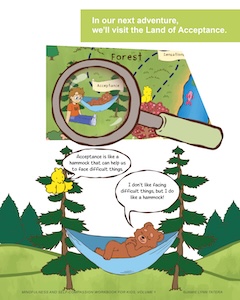
This article includes excerpts from the Mindfulness and Self-Compassion Workbook for Kids, Volume 1. The workbook invites kids to go on a quest, and Acceptance is one of 16 lands that children travel through. Please tap into your inner child and enjoy some lessons that can help you move into the hammock of acceptance.

The Land of Acceptance

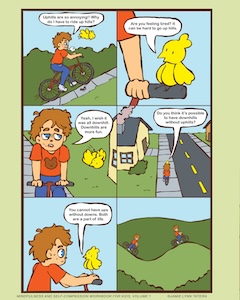
Humor is a great friend to bring along on the journey of acceptance. Life can be hard, and laughter can make difficulties easier to bear (pun intended!). In my work with kids, I juxtapose humor with life lessons.

Comic page - humor with life lessons.

Common Humanity

A tenet of many spiritual traditions is an understanding that suffering is universal, but the phrase, “suffering is a part of life” can be challenging for some adults and kids. More accessible phrases that convey a similar idea include:

Ups and downs are a part of life.
Imperfection is a part of life.

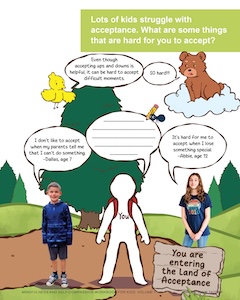
The Land of Acceptance.

Remembering that everyone has ups and downs can help us feel more connected during challenging moments. We can be mindful of our resistance to difficult feelings, and we can remind ourselves that it is human to feel as we feel. Even the struggle with acceptance itself is one that we all share. Remembering that we are not alone can give us a sense of “common humanity” when things go wrong, which is an important element of self-compassion.

Thought Distortions

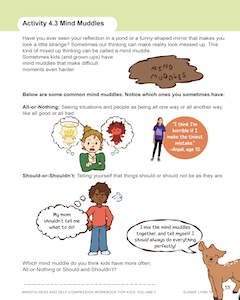
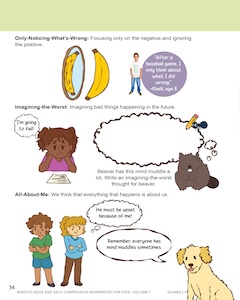
The way we think about our difficult moments can make a big difference in how we feel. Cognitive distortions like black-and-white thinking and should-or-shouldn’t thinking can make a difficult situation even more challenging. In my work with kids, I refer to cognitive distortions as “mind muddles.” The below pages highlight some common mind muddles that can compound struggles and make it harder to accept the present moment.

Mind Muddles - the activity from the workbook for kids.
Mind Muddles activity for kids
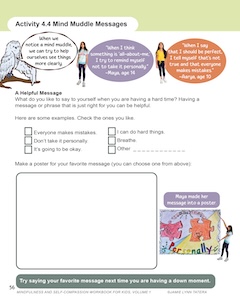
Mind Muddle Messages - an activity for kids.
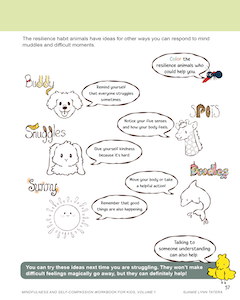
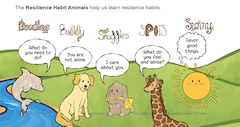
Resilience Habit Animals from the workbook for kids.

Resilience Habits

Sometimes our mind is so riddled with resistance and difficult thoughts that acceptance feels out of reach. Elements of self-compassion (and resilience habit animals) can help us come back to center:

Mindfulness (aka “Spots”)
Mindfulness meets us just where we are. If we are in a state of non-acceptance, we can be mindful of that, too. We can be mindful of all our thoughts and feelings as well as our five senses.

Common humanity (aka “Buddy”)
Whatever we are experiencing is human. We belong to humanity.

Self-Kindness (aka “Snuggles”)
We can soothe ourselves with words of acceptance and care, and we can motivate ourselves with supportive messages.

Kind Actions (aka “Doodles”)
Sometimes the choice is not whether or not we will hurt, but rather what we will do while we are hurting. We might call a friend, go for a walk, have a cup of tea, read a book, or attempt to solve a problem. Taking action in the presence of struggle is a powerful form of kindness.

Notice the Good (aka “Sunny”)
The sun is still present even when it’s hiding behind a cloud. When the time is right, we can help ourselves to notice and appreciate what is good. Remember that goodness and struggle can coexist side by side.

The Resilience Habit Animals and their resilience habits.

Self-compassion includes both tender acceptance of ourselves and our feelings as well as strong actions to try to alleviate suffering. The tender and strong sides of self-compassion are complementary. We can create change most effectively when we first bring mindful awareness to the moment and acknowledge that in this moment, things are exactly as they are. Mindfulness and self-compassion can help us move through resistance and struggle into the land of acceptance.

ABOUT THE AUTHOR

Photo of the author: Jamie-Lynn Tatera

JAMIE LYNN TATERA is a certified educator, author, and curriculum designer with a passion for helping children and their caregivers become more self-compassionate. She is the creator of the Mindfulness and Self-Compassion for Children and Caregivers (MSC-CC) program, a parent-child adaptation of the research-based Mindful Self-Compassion (MSC) training by Drs. Kristin Neff and Christopher Germer. Jamie Lynn trains educators, families and clinicians in her resiliency programs, and she has a wealth of experience teaching mindfulness and self-compassion to adults, children, teens, and families. The pages from this article are excerpted from her new book, Mindfulness and Self-Compassion Workbook for Kids, Volume 1. Visit https://jamielynntatera.com to learn more.

______________________________________

I hope you enjoyed our journey through the fourth adventure of volume 1 of my workbook for kids! I’ve heard from many adults that they find the workbook personally beneficial. And members of my paid community are moving through the workbook together. It’s a great resource for kids and grown-ups alike!

Buy the Workbook

Acceptance can be hard, but it’s the starting point for cultivating equanimity and taking skillful action.

Wishing you light, love, and equanimity,

Jamie Lynn

Parenting with Fierce Self-Compassion

An Interview with Dr. Kristin Neff

Fierce self-compassion teaches us how to protect, motivate, and care for ourselves with kindness. In this honest conversation, Dr. Kristin Neff and I explore fierce self-compassion in parenting and the messages caregivers internalize about strength and tenderness. We also share practical strategies (including a guided practice) to help caregivers grow both gentle and strong self-compassion.

Hello Friends!

I’m excited to share an interview with Dr. Kristin Neff on Fierce Self-Compassion and Parenting (view our interview below or listen on your favorite podcast app). Our conversation is rich and includes both the challenges and opportunities of integrating tender and fierce self-compassion in our caregiving, and how embodying these two energies can inform our interactions with our children.

This interview with Kristin is a breath of fresh air for parents aspiring not only to nurture their children, but also empower them to be strong and agentic. And of course, growing your own fierce and tender self-compassion skills is key to helping your child do the same.

Tender and Strong: How Gender Roles Shape Parenting

Our conversation feels especially relevant right now. It is more important than ever that we empower women, minorities, and others with diverse identities to utilize the resources of tender and fierce self-compassion. At around the 10:00 minute mark of our interview, Kristin shares about the importance of women challenging gender roles in parenting. She points out that traditional expectations can prevent boys from embracing tenderness and girls from owning strength, and she offers reflections on how caregivers can support children (and themselves) in growing into both.

I encourage you to listen until the end of our conversation where Kristin guides us through a tender and/or fierce self-compassion break that can be applied to many different situations in our lives.

Related Resources for Parents and Caregivers

Wishing you continued light, love, and fierce self-compassion!

Jamie Lynn