We Are in It Together

Why I renamed my newsletter & Comics to share with kids


Hello Friends,

If I had just one message to share with you, and one message to encourage parents to share with kids, it would be this: We Are in It Together. Again and again and again, I hear that parents and kids experience less self-judgment and overwhelm, and more resilience and well-being when they understand that there are others who sometimes feel like them.

We Are in It Together is the name is my podcast, and now it’s the name of my newsletter, too. It’s that important.

Connection is also the theme of the first “adventure” in my Mindfulness and Self-Compassion Workbook for Kids, Volume 1. Today I’ll share with you the first comic from the book as well as an activity that can help both you and your kids experience a sense of connection.

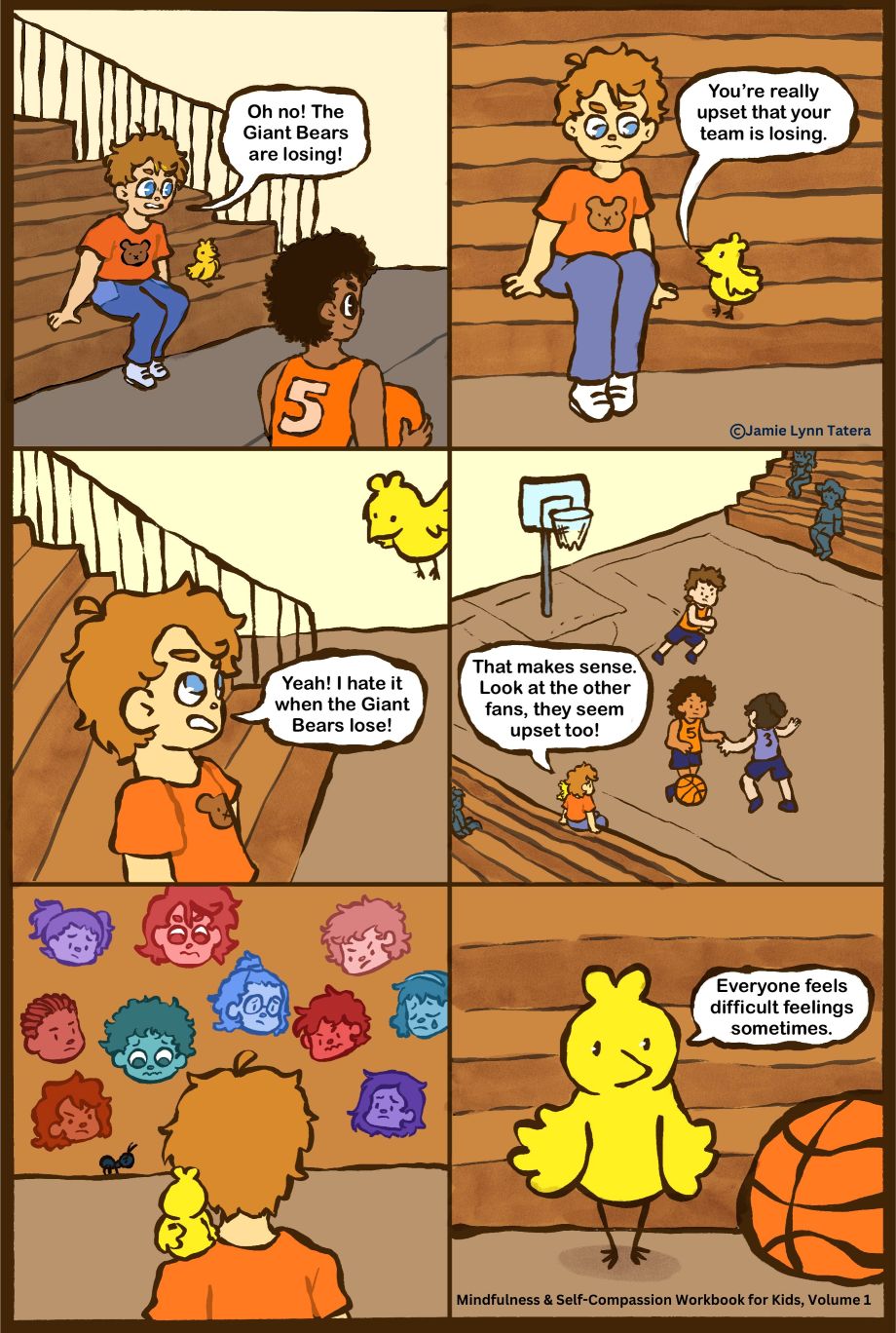
In the comic below, James is feeling frustrated that his favorite basketball team is losing. Curi (the curious chick) helps James understand that his feelings are natural and shared by others.

Comic illustrating common humanity and self-compassion for kids: a child upset that their basketball team is losing learns that everyone feels difficult feelings sometimes.

I can’t logically explain why knowing that others sometimes feel like us can make difficult feelings easier to bear, but it does. The “Buddy Habit” (click here to see the Buddy habit in action) is one of the most profoundly useful Mindfulness and Self-Compassion tools. In next week’s newsletter, I plan to share a podcast in which 17-year-old Grant shares his Mindful Self-Compassion journey, and one of Grant’s biggest ah-has from taking a mindfulness course for teens was understanding that other teens struggle like him. It is so powerful!

My workbooks, podcasts, and classes are full of opportunities for you to experience our togetherness. Getting together with a friend and sharing joys and struggles can do this for us, too.

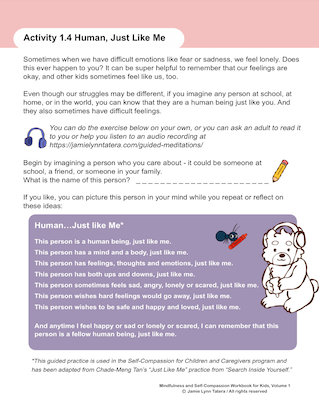
One of my favorite meditations from my Parent-Child Mindfulness and Self-Compassion class is entitled Human, Just Like Me. This guided meditation reminds us that we are not alone on this human journey. You can listen to a guided, “Just Like Me” meditation on my meditation page (the one for kids features the voices of both myself and my younger daughter). You can also read the meditation in this excerpt from the Mindfulness and Self-Compassion Workbook for Kids, Volume 1:

Workbook: Activity 1.4 Human, Just Like Me.

There are so many wonderful ways to experience our connection. I know that this newsletter is one of them for me. We are in it together! I know it in my heart.

Wishing you light, love, and connection,

Jamie Lynn

Cellphones and Silence

Hello friends,

I am back from my silent retreat. I often think of silent retreats as being like backpacking trips. Backpacking trips and silent retreats both include moments sublime, moments of intense discomfort, and I always feel better when I come home.

On retreat I thought of so many things that I want to share with you. Hopefully I will be able to share some of those thoughts in the weeks to come. But today I’d like to focus on an important topic: our relationship with technology.

Before I left for retreat, I spoke on a panel about kids and smartphones. If you’d like to see the panel I was part of, here’s a link for our talk on how to help kids be “smart” with smartphones.

Most of us have both healthy and less healthy habits on our smartphones. I wrote a draft for this newsletter on my smartphone, and some of you might be reading this article on a smartphone. I have a lot to say on this topic, and I plan do a podcast on technology and share more tips for parents in the months to come, but for today I’ll share about my personal struggles with cellphones and some tips that have helped me develop a better relationship with the apps on my phone.

One of my less healthy phone habits is checking my work email. Before my silent retreat, I had a habit of checking my work email many times a day on my phone, including before making breakfast, in between most activities, and late in the evening after I am hypothetically done working (is there such a thing when you are self-employed and work from home?). As you can imagine, my email checking creates a lack of boundaries between my work life and my home life.

It was a challenge during my silent retreat not to check my work email. I realize that I get a sense of “control” and “agency” as well as a confidence boost that my mission for spreading self-compassion is gaining force when I check my work email. I think it also makes me feel productive and important. Are these good things? Sometimes. But they also pull me away from the present moment. And an email (or a social media “like,” etc.) is a poor substitute for looking inward and finding a sense of being okay and worthy on the inside or looking around us and finding connection in the here and now. Deep thoughts, I know. Retreats will do that to you ;).

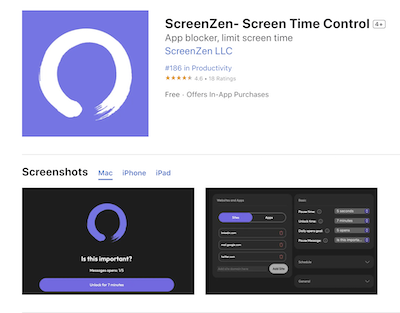
So, what am I doing to help with my phone habits now that I am back from retreat? I’ve installed a wonderful app called ScreenZen on my phone. I have programmed it so that certain apps, including my gmail and my Instagram, have not only a limit on how many times I can open them, but also a message that pops up that helps me pause before I do so. Now, before I read my work email on my phone, I pause and say a mantra or prayer. And before I open my Instagram, I take a few deep breaths or do some “square breathing.” Does this make a difference? Absolutely! Because these new habits are helping me be present and experience my okayness and connection from the inside.

ScreenZen-Screen-Time-Control. App Blocker - limit screen time.

I promise to share more about how to help kids with their screentime in a future newsletter, but I think it’s a really good idea for us to start with our own technology use. Maybe you want to try the ScreenZen app, too (or share a different helpful app or strategy that you use in the comments)!

Wishing you wellbeing from the inside out,

Jamie Lynn

P.S. If you’re interested in taking a class to help with present moment awareness and self-kindness, you can visit my events page for a list of upcoming opportunities.

See upcoming opportunities

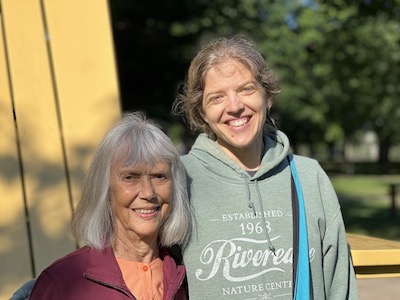
P.P.S. Here’s a picture of a delightful Swami (Swami Radha) who guided many practices during my silent retreat. She reminded me that in addition to my loving kindness phrases, using a mantra can be a great way to meditate.

A picture of a delightful Swami (Swami Radha) who guided many practices during my silent retreat.

Fierce Self-Compassion

Hello Friends!

You may be familiar with the 4 S’s of attachment: Seen, Safe, Soothed and Secure. Well, I’d like to add a 5th S: Strong!

Ever since Kristin Neff published her book, Fierce Self-Compassion: How women can harness kindness to speak up, own their power, and thrive in 2021, I have been drawn to the concept of fierce self-compassion. It’s interesting to note how some families teach their kids to be strong, some teach their kids to be tender, and some teach their kids to be both (or neither). Growing up, I learned to be strong in some ways, but mostly I learned how to be tender and how to care for and nurture others. You might notice that the title of Kristin’s book addresses women. This is because most women have been socialized to prioritize community over agency; tenderness over strength. And many men have been socialized the opposite way. Unfortunately, in these sexist systems of socialization, everyone loses and everyone is less whole.

But it doesn’t have to be this way. Men can embrace their tenderness, and women can embody their fierceness. We can all be both strong and gentle; we can all be whole.

What Is Fierce Self-Compassion?

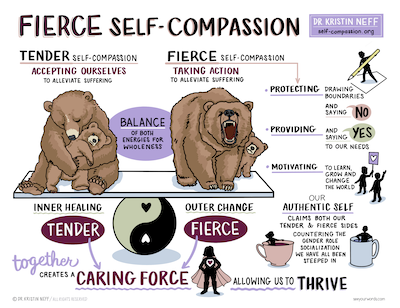
According to Kristin Neff, fierce self-compassion includes the ability to protect, motivate, and provide for oneself with kindness. It complements tender self-compassion, and we all need both tender and fierce compassion to thrive. A fierce mama bear protecting her cubs is a good metaphor for fierce compassion. And fierce self-compassion is taking this mama bear energy, and turning it inward to protect and provide for yourself. Kristin created this wonderful diagram that illustrates the differences between fierce and tender self-compassion.

Dr. Kristin Neff's image: Fierce-Self-Compassion: How tender and fierce creates a caring force

Note: Dr. Kristin Neff is a pioneering self-compassion researcher and author of Fierce Self-Compassion, and her work deeply informs how I teach and practice these skills with adults and families.

My Journey with Fierce Self-Compassion

In future reflections, I plan to highlight each of the three elements of fierce self-compassion (protecting, motivating, and providing). Today, I want to share how “providing” self-compassion has been both my biggest challenge as well as my area of recent growth.

But first, a bit about my teaching journey. Because I thrive in community with others, I taught a Fierce Self-Compassion practice group based on Kristin Neff’s Fierce Self-Compassion book long before there was an official Fierce Self-Compassion course. Years later, I completed the Fierce Self-Compassion Teacher Training through the Center for Mindful Self-Compassion, and began teaching Neff’s Fierce Self-Compassion course.

Teaching fierce self-compassion has been both a pathway for helping others, as well as a catalyst for my own growth. Due to gender socialization, it was hard for me to let myself focus on providing for myself. I had a little internal voice that said it was “selfish” to provide for myself. But, I am developing another internal voice. This new voice says it’s my birthright and EVERYONE’S birthright to provide for themselves. I don’t provide for myself instead of others. Rather I provide for BOTH myself and others. And in fact, the more I provide for myself, the more I will be able to provide for others.

Here are two ways that practicing “providing” fierce self-compassion has manifested in my life:

  1. My husband(-like thing) and I made an offer on a house. No, we did not get the house, but believing that I CAN provide for myself made me courageous enough to make an offer with him.
  2. I am going on a silent retreat next week. This is a very big deal. I have not been on a silent retreat since I had my younger daughter almost 12 years ago. But fierce self-compassion is helping me believe that I am worthy of taking the time to care for myself.

It’s crazy how much internal pushback I experience as I strengthen my ability to motivate, protect and provide for myself with kindness. And it is empowering to see how my own example is being taken in by my two daughters. Both our modeling and our treatment of children shape how children treat themselves. Kids learn to be strong by us providing them with a balance of tender nurturing as well as confidence in their resilience and abilities. And children develop inner strength by watching their caregivers do the same (tenderly nurture ourselves and confidently move about the world).

For parents and caregivers, fierce self-compassion supports loving boundaries, advocacy for our children and ourselves, and modeling courage alongside kindness.

Related Reflections and Resources for Parents and Caregivers

If you’d like to explore how fierce self-compassion can support both you and the children you care for, here are a few places to begin.

Working Skillfully with Anger

Another important part of our fierce self-compassion journey is learning to own and effectively channel anger. When we learn to listen to anger with wisdom and kindness, it can become a powerful ally for protection and positive change. I share more about this in my post, Befriending Anger.

Learning and Practicing Fierce Self-Compassion

I am so on fire about supporting others, including you, to own our inner strength. Here are three great ways to grow your tender and fierce self-compassion, and allow the goodness to ripple out:

The books, resources, and classes I’ve shared can help to steady you on the path to fierce self-compassion.

Wishing you both tender nurturing and empowering strength,

Jamie Lynn

Can you be Jealous AND Happy?

An Emotional Intelligence Boosting Exercise for Kids and Grown-Ups

Have you ever told yourself that you shouldn’t feel jealous of someone? Me, too. Thinking that we shouldn’t feel jealous, or angry, or __(fill in the blank with the emotion)__ is common for kids and grown-ups who have the “deer” feelings habit. Those of us who have the deer habit are likely to suppress or feel ashamed when we feel jealousy. But it’s not just those of us with the deer habit who suffer. Those with the chameleon habit are likely to deny that jealousy is arising, and those who have other feelings habits may feel consumed with their jealousy. Note: You can read my Feelings Habit Animals article if you’re new to my blog and unfamiliar with the feelings habit animals.

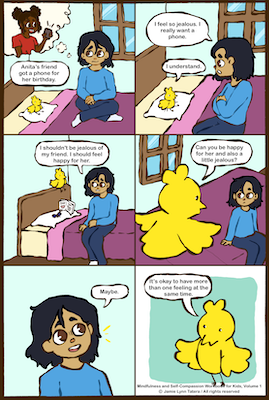
In volume one of the Mindfulness and Self-Compassion Workbook for Kids, Anita is the comic character who struggles with shame-prone feelings. In the comic below, Curi (the helpful and curious chick) helps Anita when she struggles with the emotion of jealousy:

Comic from the book: "The Quest for Self-Compassion.

Curi helps Anita understand that it is okay to feel jealous, and that jealousy does not have to be the only emotion that she experiences. We can feel both jealous of someone, and also happy for them. Sometimes the jealousy is big and the happiness is little, and sometimes it’s vice versa. Either way, we are still a good person having a human emotion.


NOTE: Be sure to scroll down for upcoming opportunities to help youth (and you!) grow mindfulness and self-compassion.


The idea that we can feel more than one emotion can be liberating to adults and kids alike. Creating space for more than one feeling can lessen the urge to suppress or obsess about feelings, which can help us find more balance in the midst of challenging emotions.

In the video below, my daughter, Maya, and I do a wonderful activity for kids that demonstrates this concept. During the second half of the video we do an exercise from my Parent-Child Self-Compassion class known as “share the plate.”

Share the Plate.

Share the plate reminds us that we can allow multiple emotions to coexist side-by-side.

As you watch the video, you might consider a time when you felt jealous. Was there more than just jealousy? Can you wrap your difficult feelings in a metaphorical blanket of self-compassion as we do in the video? Can you remind yourself that everyone feels jealous sometimes, and give yourself kindness because jealousy can be a challenging emotion?

And can you be a little bit curious, when the time is right, about other positive emotions, too?

Ironically, when we allow ourselves to embrace multiple emotions with curiosity and compassion, the challenging emotions can become less sticky.

There are a wealth of upcoming opportunities to to grow your own self-compassion and learn to share self-compassion with youth including:

So many great opportunities to grow the resilience boosting power of mindfulness and self-compassion!

With Love,

Jamie Lynn

Youth Resilience and Self-Compassion with Dr. Karen Bluth

Child and Teen Mindful Self-Compassion Researcher, Author, and Educator

Hello Friends!

Would you like to give your kids (and yourself!) a resource that can aid in coping with challenging situations and thriving? Join Dr. Karen Bluth and me for an honest conversation about the struggles that youth face and how self-compassion can help in this month’s We Are in It Together Podcast episode. You can listen to our conversation on your favorite podcast app, on Substack, or on Youtube.

Dr. Karen Bluth is a researcher, author, educator, and Mindful Self-Compassion for Teens program creator and teacher, and truthfully, her teen program inspired me to create the Parent-Child Mindfulness and Self-Compassion program that is the backbone of my work (I just added a parent-child class for fall)!

Early intervention can help to prevent future problems. Self-compassion increases mental health, and also offers a protective mechanism from the secondary problems that can arise when kids experience depression, low self-esteem, and set-backs. Learn about the research and practices that can bolster youth resilience.

Karen and I talk about our own struggles as teens, and the best strategies for helping kids grow self-compassion (including us grown-ups modeling it!). To learn more about Dr. Karen Bluth’s work, visit https://karenbluth.com/.

I would love to see you at an event this July, August and/or September. In addition to my podcast, there are many upcoming workshops and courses for you to grow your own self-compassion and/or learn to share self-compassion with youth including:

So many great opportunities to grow the resilience boosting power of mindfulness and self-compassion!

With Love,

Jamie Lynn

P.S. Thanks again to all who shared feedback on the cover and title for the Mindfulness and Self-Compassion Workbook for Kids, Volume 1 (formerly known as the Quest for Self-Compassion). Here’s a draft of the new cover:

Feedback on the cover for the book: "Mindfulness & Self-Compassion Workbook for Kids, Volume 1".