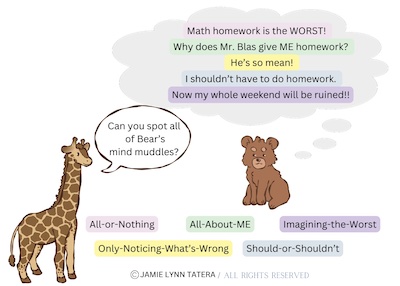
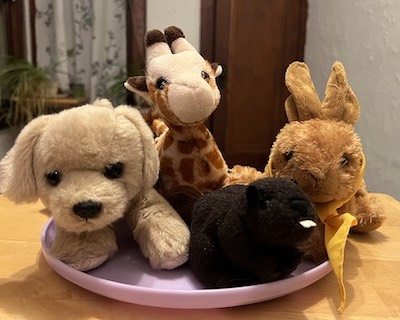
Once children are adept at noticing and labeling the mind muddles of their stuffed animals, you can begin labeling your own mind muddles out loud, and then eventually help kids identify their own.
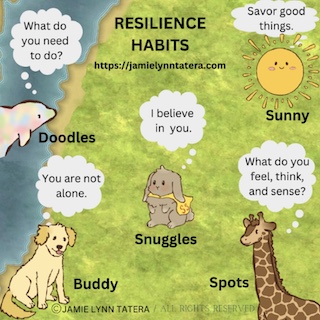
In a recent study (not yet published) of the Self-Compassion for Children and Caregivers program, the number-one resilience habit that kids reported using was the “Buddy habit.” Buddy the dog is the resilience habit animal that helps us to remember that we are not alone when we experience hard things. Children reported that the “Buddy habit” helped them with all kinds of difficult feelings:
“I find the Buddy habit really helpful, whereas before . . . I was like ‘I’m the only person going through this.’”
“The Buddy habit . . . taught me that everyone has feelings like this sometimes.”
Remembering that we are not alone can be especially helpful for kids dealing with social anxiety-related thoughts and feelings. Children with social anxiety are typically shame-prone and fearful of being negatively perceived by others. These children are often aware that their anxiety is not socially appropriate. Sometimes well-meaning adults tell kids that they “shouldn’t” feel anxious, but this just tends to compound kids’ anxiety and shame. What a child needs to hear instead is that other kids and grownups sometimes feel anxious, too. When an adult says, “Did I ever tell you about the time that I….” and shares about when they felt social anxiety, it creates a bridge to their child’s experience and helps the child internalize that they are not alone.
Caregivers can also expose their children to books in which the protagonists struggle with anxiety. Are You Mad at Me? is a delightful children’s book that tackles the topic of social anxiety in a playful way. When I left the book on a table in my living room, both of my daughters carefully read and reread the book. My younger daughter said, “What I love about it the most is that I can relate to it so much.”
JL Note: I interviewed the authors of Are You Mad at Me for my first, We Are in It Together podcast. You can view or listen to our podcast here, or wherever you like to listen to podcasts!
Self-compassion is an antidote to shame, and studies of adults and youth who have taken self-compassion training have found significant decreases in their anxiety symptoms. In a nutshell, self-compassion invites us to learn to treat ourselves with the same kindness that we would offer to a good friend.
When I teach children about self-compassion, I introduce Snuggles the bunny. Snuggles can soothe us with kind words when we are struggling. Reassuring words include, “You are not alone, I’m here for you, and I care about you.”
When Snuggles dons a cape, it’s Super Snuggles. Super Snuggles can help kids to do hard things, including facing their anxiety fears. Super Snuggles likes to say, “I believe in you. You can do hard things. You’ve got this.”
One parent-based treatment program, Supportive Parenting for Anxious Childhood Emotions (SPACE), teaches parents to provide their children with both validating and encouraging words. Children need to know that adults understand their struggles with anxiety-related feelings and thoughts. They also need to know that we believe that they can handle their anxious feelings and do hard things.
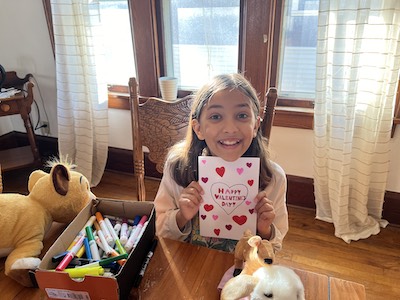
Let’s return now to Anjali’s fear of creating a card for her grandmother. I know a little bit more about this story, because I happen to be Anjali’s mom. And because I’m a self-compassion-for-children teacher, I was able to help her identify and name her fear, and understand that she was not alone; and I offered her both gentle validation and strong encouragement. We talked about the pictures and words she wanted to create, and with some effort she created the cover of the card. But when it came time to write the interior, she again froze. Aren’t you glad that I chose an example that did not have an easy ending!?
In Anjali’s case, she needed extra support to complete the interior of the card. Her anxiety was preventing her from putting words on paper, but she was able to engage in conversation about what she might want to say to her grandma. I recorded her words on my phone, and then I replayed the words and sat with her as she wrote the words in the card.
After her grandma’s card was complete, we called Grandma, who squealed with delight as Anjali shared it with her. I encouraged Anjali to soak in the goodness of her grandmother’s joy. We then together retold the story of her anxiety and connected it to the joy that she brought her grandma by creating the card despite her fear.
Often kids with anxiety want to avoid events that trigger their fear, but avoidance only compounds their anxiety over time. This is why recommendations for social anxiety emphasize helping children move forward in the face of fear.
Supporting children when they have anxiety is critical, and it’s also important to progressively help children learn to face fears independently. In the parent-based treatment program, SPACE, parents are taught to gradually reduce their accommodations to help children learn that they can cope and move forward in anxiety-provoking situations on their own.