More than One Feeling

When Gratitude Meets Dread: Letting Two Emotions Be True

Hello Friends,

Sometimes in life we have two very different emotions at the same time. For example, when I was preparing to chaperone my daughter’s 8th grade Spanish class field trip to Costa Rica, I felt grateful to for the opportunity, and I also felt overwhelm and dread at the prospect of traveling with 40 middle school students for ten days. 

As someone who’s become more of an introvert over the past decade, I had to remind myself: it’s okay to have more than one feeling about this.

Permission to feel more than one emotion simultaneously is one of the most liberating lessons I teach children and caregivers. It’s such a relief to not have to choose between gratitude or dread. We can feel both. We don’t have to gaslight ourselves into being only grateful (that’s repression), and we don’t have to get lost in the challenges either. Life—and parenting—is full of beauty and challenge, often side by side.

Big and Little Feelings

Sometimes one feeling is loud and the other feeling is barely a whisper. You might feel deeply frustrated and a little grateful. Other times, you might feel mostly joyful with a tinge of frustration or overwhelm.

One of the graphics in Volume 1 of the Mindfulness and Self-Compassion Workbook for Kids brings this idea to life with visuals and examples kids really connect with.
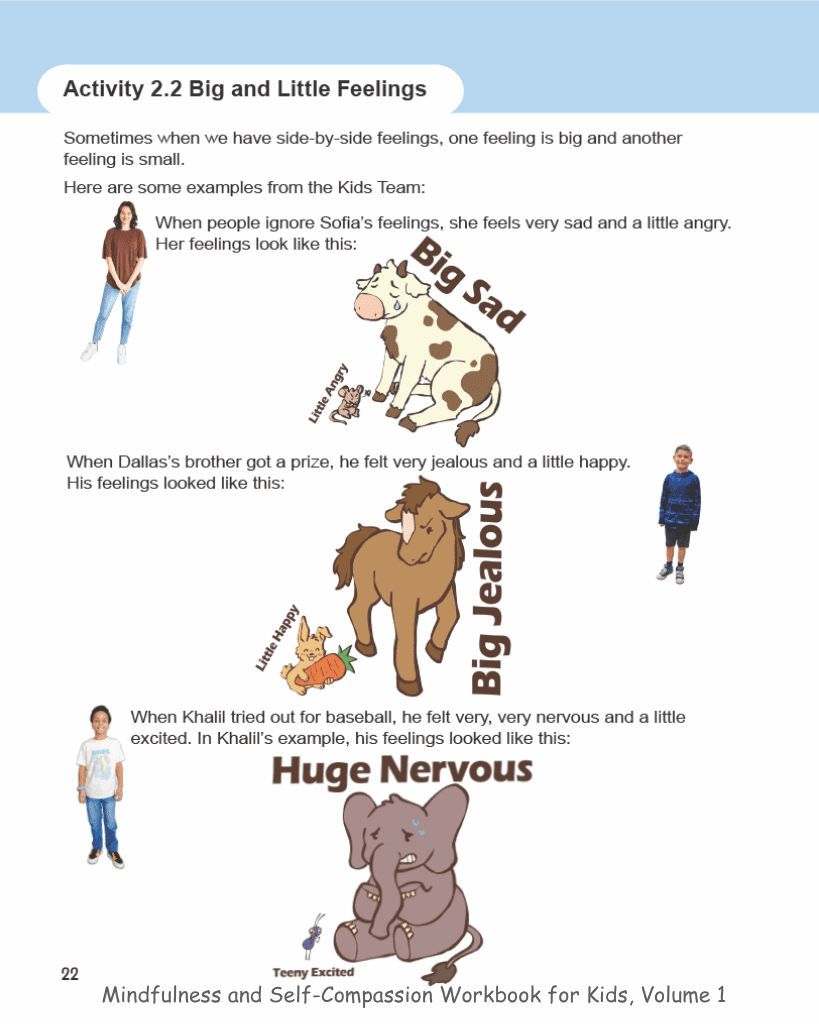
Animals and children depicting different sized emotions

The permission to feel more than one feeling is part of the “Land of Freedom“—one of 16 lands (core ideas) from the workbooks. When kids learn to allow multiple feelings, they often experience a feeling of freedom—not ruled by emotions and not pushing them away either. It can feel like a long exhalation!

More Examples of Side-by-Side Feelings

If this idea is new for you (or your kids!), examples can really help it land. Here are a few from past blog posts:

When my daughter made it to State with her cross country team, she was elated and celebrated. But when the weekend ended and the season was over, she felt the natural letdown.

Joy and disappointment—side-by-side.

During these challenging times, I remind myself again and again to create space for AND. AND what? you might ask. By AND, I mean allowing for both sadness and joy. Loneliness and connection. Despair and hope. If we don’t create space for all of it, we run the risk of either anxiously clinging to positivity, or conversely, wallowing in despair.

I feel like it’s still relevant today, right!?

  • One more example: we can be jealous (technically envious) of someone else, and also be a little happy for them. Here’s a blog I wrote on being both happy and jealous. Below there’s a video featuring a comic from the workbook on this topic and a conversation between my younger daughter and me on how we can feel these two emotions simultaneously.

Share the Plate

In my parent-child mindful self-compassion course, we take this to the next level through an activity called “Share the Plate.” Kids and parents imagine different feelings sitting on a plate together—no need to push one off to make room for another. We use props and a guided activity to make this idea come to life. Learn more about the class here.
If you’d like to explore this metaphor more, you can watch the “Share the Plate” video and read this related blog.

If you’d like to help your child feel free to feel all their feelings, you can share this “share the plate” metaphor with them. You can also begin to share your side-by-side feelings in daily life. Every time you do, you’re helping your children know that it’s human to have a range of emotions, and that you’re a safe person to share those feelings with.

May you and your children feel the freedom of welcoming all your feelings—with joy and compassion!

With love,

Jamie Lynn

P.S. Here are a couple of photos from when I chaperoned my older daughter’s Spanish class trip two years ago. Yes, I’ve done this trip before—so I knew what I was getting into.
I chose pictures from the day Maya got sick and we stayed back from the group outing. It was a day full of side-by-side feelings—and ironically, one of my favorites from the whole trip.

Maya at the doctor's office in Costa Rica
Jamie-Lynn and her daughter Maya at the Spanish class field trip to Costa Rica.

Pictures from my older daughter’s Spanish class field trip to Costa Rica on the day she got sick.

Five Signs that Your Child May be Struggling with Shame

And How Self-Compassion Can Help!

Hello Friends!

In a recent podcast interview, I was asked an important question: What are signs that a child needs self-compassion?

A few common behaviors indicate that a child could really benefit from self-compassion, including:

  1. Unwillingness to try challenging tasks or trying half-heartedly (fear of trying and failing)
  2. Perfectionism or unrealistic self-standards (fear of being not good enough)
  3. Unwillingness to own mistakes or over apologizing (fear they won’t be loved if they fall short)
  4. Low distress tolerance (difficulties self-soothing)
  5. Being self-critical (sometimes overt, and sometimes inferred from the above)

Interestingly enough, these are all signposts of shame. Fear of failure is ultimately fear of judgment—whether from ourselves or from others, real or imagined.

Note: If your child is neurodiverse or in any way marginalized by society, they may be even more vulnerable to shame — and even more in need of self-compassion.

Self-Compassion is the Antidote to Shame

Chris Germer, psychologist and co-author of the Mindful Self-Compassion program, has taught me a great deal about self-compassion for shame. “Shame isn’t the problem,” he reminds me. “It’s how we respond to it that matters.” The first three signposts above were shame avoidance strategies. Avoiding shame through perfectionism or withdrawal only makes it grow. Similarly, diving headfirst into shame and believing its negative messages is unhelpful.

So if we don’t want to avoid shame or believe shame, just what do we do!? We learn to relate to shame effectively.

Learn to be with your own shame

Ultimately, shame is a doorway. And learning to be skillful with your own experience of shame is key to unlocking yourself from its painful grip. I share practices that parents can use for skillfully being with shame in my interview with Chris Germer for my Compassionate Parenting course. I later shared this touching and poignant interview as the final episode of Season 1 of my podcast.

Model for Kids How to be Skillful with Shame

Once you begin responding more skillfully to shame (and yes, it takes time!), you can show your kids what that looks like. Your modeling can help kids understand that they don’t need to avoid or fear shame—they can face it head on!

Here’s an article that I wrote about how I modeled walking through shame in the presence of my daughter: https://jamielynntatera.com/2024/03/shame-kids-and-grown-ups/.

How I used Deer — the feelings habit animal for shame-proneness — to make my own shame experience relatable and accessible to my daughter.

In the blog, I describe how I used Deer — the feelings habit animal for shame-proneness — to make my own shame experience relatable and accessible to my daughter.

Keep Learning and Growing

One of the most important things to remember is that shame avoidance will make your (child’s) world smaller. And self-compassion can help you and your child’s world get bigger. Equipped with the resource of self-compassion, there’s nothing that you can’t tackle! Self-compassion-related books, classes, and conversations will all help your child and you grow shame-resilience skills.

I’ve been working hard to ensure that my self-compassion classes for all ages are available in both live-online as well as self-paced formats. Listening to self-compassion related podcasts and guided meditations can help too!<

Keep returning to this simple truth: you and your child are lovable exactly as you are. Shame is ultimately a mirage, but it’s a tricky one that requires the lens of self-compassion to see through.

Wishing you light and love,

Jamie Lynn

P.S. If you’d like to go deeper, I’m offering a free Companion Masterclass this Wednesday on helping kids work with perfectionism, self-criticism, and shame. You’re welcome to join live or receive the recording. You can learn more here.

Befriending Anger

What if anger can be a force for good?

Hello Friends!

Last Friday we celebrated the 4th of July in the US. For those who celebrate, did you feel a mix of feelings? Personally, I felt a big mix—happiness for good things (like friends and family), outrage and despair about some of the things happening on the political landscape of this country, and exhaustion. Each of us may have had our own mix, and all of the feelings belong.

Today, I’d like to highlight the powerful emotion of anger. Anger is a fascinating emotion—a potentially powerful force for motivating positive change as well as a potentially destructive emotion. As I say in Volume 2 of my workbook for kids, “Anger is like fire. Use it with care.”

Fire with quote Anger is like fire. Use it with Care.

But what does it mean to use anger with care?

How do we skillfully channel anger's power?

Disclosure and disclaimer: My lessons from anger have been shaped by Kristin Neff’s book, Fierce Self-Compassion: How Women Can Harness Kindness to Speak Up, Claim Their Power, and Thrive. It’s important to note that her book was written with a focus on women. Additionally, I am a cisgender woman, which means that my hormone profile and lived experiences growing up are female. For these reasons, my experiences and suggestions do not necessarily equally apply to all. This post, and my teachings on anger, may be more helpful and relevant to those who have been socialized as female. Additionally, I’m not a therapist, so please use your own wisdom and consult with professional resources as needed to find skillful ways to relate to your anger.

Step 1: Learn to View Anger Differently

I was originally going to write, “Learn to be with your anger” as step 1, but I don’t think that’s actually the first step. For people like me who have been taught that anger is bad (have you ever heard how people treat and talk about angry women?!), the first step in transforming our relationship with anger is to befriend it.

Fierce Self-Compassion

There is an exercise from pp. 77-78 of Kristin’s Fierce Self-Compassion book entitled, “Understanding Your Anger” that unlocked something for me. She instructs you to think about a time when you got angry at someone else, and then she invites you to reflect on a series of questions about your anger, including…

  • How did your anger express itself?
  • Did it have any constructive or destructive results?
  • How did you feel after getting angry?

This first set of questions cultivate mindfulness of your experience of anger, which is helpful and needed, but was not transformative for me. The next questions take it deeper:

Can you be curious about what your anger may have been trying to do for you? Was it trying to point out a danger or protect you in some way, even if the end result of your anger wasn’t beneficial? (For example, was it trying to prevent you from being hurt, or help you to stand up for the truth or draw clear boundaries?)

Note: I bolded the words that jumped out at me from the exercise, which played into the next instruction:

  • “Try writing some words of thanks to your anger for its efforts to help you. Even if the methods your anger used to express itself were not ideal or the consequences of your anger were not actually helpful, can you honor this energy inside of you that was trying to protect you?”

OMG, I had never thought of this. I had never thought about honoring the positive intention behind my anger, even when my execution was unskillful. I proceeded to write a letter of thanks to my anger, and my relationship to my anger was forever changed.

Anger was my ally! I just had to learn how to listen to it, be with it, and channel it effectively.

I will share more on these latter parts in the weeks and months to come, but I’d like to stop here with an invitation to begin to befriend your own anger. It is here to protect and empower you…for good! We just need to learn how to be with it, understand it, and harness its potentially caring force.

Note: There is an early bird discount on my Fierce Self-Compassion (FSC) course this month. FSC teaches us to harness our own caring force! Learn more about Fierce Self-Compassion HERE.

Thank you for being on this self-compassion journey with me. I welcome all parts of you on this journey (including your angry parts!).

With love and caring force,

Jamie Lynn

Break the Cycle

An Intergenerational Invitation

Dear friends,

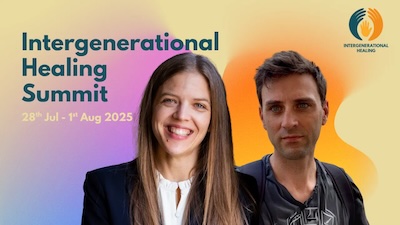
We all have wounds that we consciously or unconsciously carry, and unless we take steps to heal ourselves, these wounds are passed down to the next generation. For me, self-compassion was key to healing my wounds and empowering my kids to do the same. The mission of intergenerational healing is so near and dear to my heart that I co-created the Intergenerational Healing Summit to help us all heal and support the next generation.

This summit is your invitation to break the cycle — and create a more connected, compassionate legacy for yourself and our youth.

I invited Dr. Chris Willard to co-host the summit with me because in addition to being an amazing dad, psychologist, children’s book author (including Feelings Are Like Farts), and member of the Harvard Medical School faculty, he’s also an amazing person. Chris arrives with authenticity, and he and I were able to go deep and keep it real with the people we interviewed. I can’t wait to hear Chris’s interviews the last week in July!

Intergenerational Healing Summit

Please help me share! The summit launch is July 28, and I could use your help in sharing the summit goodness. First, you can sign up here: https://www.globalcompassioncoalition.org/our-courses/intergenerational-healing/. Then, you can share the link with people you care about who could benefit from growing their own resources of mindfulness, self-compassion, and nervous system regulation (in other words, all of us!). You can also share with anyone who cares about kids. In the summit we explore tools to help ourselves AND help the children in our lives.

In the next few weeks I will share about some of my interview highlights, including this favorite with Rick Hanson who is the founder of the Global Compassion Coalition.

The summit is free July 28 through August 1st, but if you’d like unlimited access, there’s an option to purchase a summit package. All proceeds will support intergenerational compassion programming. How sweet is that!?

Wishing you light, love, and intergenerational healing,

Jamie Lynn

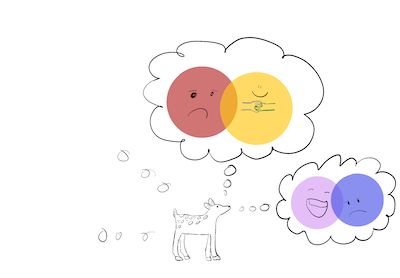
P.S. My dear friend and colleague, Brienne, is helping me create a preschool adaptation of my mindful self-compassion curriculum for schools. Brienne is a gifted curriculum writer and special education teacher for early childhood. My daughter, Anjali, was giving me feedback on a couple of the storybooks. Here’s a sketch that Anjali began of Deer having “side-by-side” feelings. I can’t wait to share more as the project evolves!

Anjali's sketch of Deer having “side-by-side” feelings.

A Book Club for Your Inner Child

And a Summer Update! ?

Hello Friends,

I have long been delighted by the many ways caregivers use the Mindfulness and Self-Compassion Workbook for Kids, including parent-child pairs, school groups, kids in private therapy sessions, and even parenting groups!

Lately I’ve been hearing about another deeply touching use: healing (or simply playing with) your inner child. ?

And now, we can take it to the next level: a playful, healing book club (or a do the bookclub) for adults who would like to explore the workbook together—and tend to their inner children in community.

A playful book club for your inner child.

Last week I received this email from Devika, a wonderful Mindful Self-Compassion graduate who would like to guide a group through the Mindfulness and Self-Compassion Workbook for Kids, Volume 1:

Hi Jamie Lynn

Thank you for creating such a valuable and beautiful workbook for children. It made me wonder how helpful it would be if we, as adults, used this approach to learn/enhance our self compassion and mindfulness skills, as personally I found it very accessible, fun and of course it could be greatly healing for our inner child!

I would love to work through the book in community, and am happy to start a book club. Anyone who would like to be part of this, please email Jamie Lynn and she will send your details to me.

Best of wishes

Devika

If you (or your inner child) would like to join Devika’s book club, reply to this email, and I will connect you!

Also, a quick reminder:

My most accessible, approachable teacher training is now open, and there’s still time to join! My level 1 training is a 2-in-1: you can learn to teach kids and playfully nurture your inner child along the way.

Wishing you and your (inner) children love, compassion, and joy!