What is Your Feelings Habit Animal?

The Feelings Habit Animal Quiz comes from the Mindfulness and Self-Compassion Workbook for Kids, Volume 1. This page shares the full Feelings Habit Animal Quiz and its results, with a link to the digital version.

These habits are part of a larger system that also includes the Resilience Habit Animals, which help children respond to their feelings with care.

Workbook header

There is nothing that can get a group of kids to roll their eyes like talking to them about feelings. The topic of feelings for most kids (and many grown-ups) is boring at best and painful at worst.

When I instead begin the conversation about feelings by introducing the five feelings habit animals, I get a very different response from children: curiosity. When I show kids my deer, bear, beaver, chameleon, and dragon feelings habit animals, and I talk about my own feelings habits, kids become curious about their own tendencies. Then I have them take the feelings habit animal quiz.

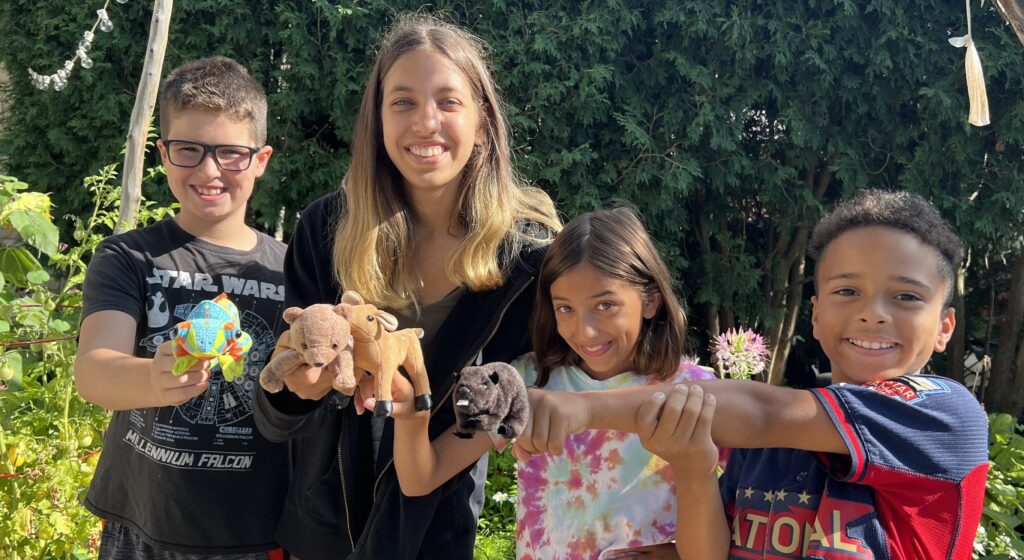
Children with their feelings habit animal

Many Possibilities…

Six simple questions can give kids and grown-ups clues about their feelings habits. Even though the questions are simple, our responses can be varied. You might have multiple responses to a single question because part of you feels one way, and another part of you feels a different way.

Here’s a personal example of having multiple emotions in response to a situation: When my husband gets very busy with work and doesn’t have time to spend with me, a part of me feels indifferent or even happy. His busyness gives me time to work on my own projects and do whatever I want to do. However, another part of me thinks that he doesn’t love me. The second part is a small, child-like part of me that is not rational, but it is still there. So if, “Your friend is too busy to play with you” were a question on the quiz, I would put two answers (“I don’t care” and “I think they don’t like me”) because both are aspects of my internal response.

The Feelings Habit Animal Quiz (Questions)

© 2024 Jamie Lynn Tatera. From the Mindfulness and Self-Compassion Workbook for Kids, Volume 1.

If you didn’t yet take the 6-question Feelings Habit Animal quiz, I’d invite you to do so now. Answer the questions below as you would have when you were a child, and discover your childhood feelings habit animal. Then take it with your child and get curious how each of you would respond now. Many of us have more than one feelings habit, so if you write down your responses (a, b, c, d and/or e) on a piece of paper as you go along, you will get a fuller picture of your feelings habits, which might include multiple animals.

Choose the option(s) that best describes how you would respond to each situation below. There is no right or wrong answer, so just choose what seems true for you. It’s okay to pick more than one answer for a question. If none of the answers fit, you can write your answer under “e” other.

1. Your friend doesn’t play with you during recess. Do you…

a) Think about it the rest of the day
b) Get really mad or mope and feel sad
c) Tell yourself that you don’t care
d) Think that your friend doesn’t like you anymore
e) Other _____________________

2. You did poorly on a test that you studied for. Do you….

a) Keep thinking about it over and over
b) Get really frustrated or disappointed
c) Convince yourself that it doesn’t matter
d) Think that you’re not a good student
e) Other ____________________________

3. Your parent yells at you because you are running late for school or for some other reason. Do you…

a) Think about it at school
b) Yell back at your parent or start crying
c) Ignore your parent
d) Tell yourself you’re a bad kid
e) Other ________________________

4. If your friend was feeling sad, would you…

a) Keep asking them why they are sad
b) Feel really sad because they are sad
c) Pretend like you don’t notice
d) Wonder if you did something to make them sad
e) Other ________________________

5. You feel upset and your friend or parent asks you what’s wrong. Do you….

a) Tell them detailed stories about what happened
b) Let all your feelings come spilling out
c) Shrug your shoulders and say you’re fine
d) Not tell them because you don’t want them to feel bad, too
e) Other _____________________________________

6. A friend or sibling is better than you at something that you have been trying hard to improve. Do you…

a) Keep thinking about how they are better than you
b) Feel very angry or disappointed that you can’t level up
c) Tell yourself that you don’t really care about being good at the activity anyways
d) Tell yourself that you shouldn’t feel jealous
e) Other _____________________________________

About This Quiz:

The Feelings Habit Animal Quiz was created by Jamie Lynn Tatera and comes from the Mindfulness and Self-Compassion Workbook for Kids, Volume 1. This page shares the original quiz as an educational resource. Please include attribution and a link back to this page when referencing this work.

Take the Feelings Habit Animal Quiz (Digital Version)

Often kids (and grown-ups) prefer to take the quiz digitally. The digital quiz linked into the image below includes pictures for each quiz response, which makes it more engaging for young learners. 

A printable version of this quiz will be available in the future for classroom, therapy, and family use.

What are the 5 feelings habits?

Feelings Habit Animals - Jamie Lynn Tatera - Compassion for Kids.

Count up the number of different letters that you chose in the quiz. Whichever letters were most common for you, please know that you are not alone! However you respond to your emotions, it makes sense, and there are others who feel like you.

The quiz results for the five feelings habit animals are described below (four core habits, plus a fifth that represents a mix).

Beaver

If you chose mostly A’s, your feelings habit animal is a beaver. Emotions can be sticky for you. Your mind replays situations over and over. A sticky mind can be tricky, but it can also be STRONG.

Bear

If you chose mostly B’s, your feelings habit animal is a bear. You feel BIG feelings. It’s healthy to feel our feelings, but big feelings can sometimes be hard to manage. Being sensitive can also be a gift.

Chameleon

If you chose mostly C’s, your feelings habit animal is a chameleon. Sometimes your feelings hide, or you distract yourself from them. Avoiding feelings can cause problems over time, but shifting your focus can also be helpful.

Deer

If you chose mostly D’s, your feelings habit animal is a deer. You sometimes think it’s not okay to feel your feelings. Shame can make you feel bad about yourself, but caring deeply is a strength.

Dragon

If you chose mostly E’s, you might have a mix of different ways you respond to feelings. It’s common for feeling habits to be tricky in some ways and helpful in other ways.

How do you normally respond to your feelings? It’s common for our habits to be tricky in some ways and helpful in other ways.

If you’re looking for the Feelings Habit stuffed animals used in the books and classes, you can find links here.

What do I DO about my feelings habits?

When adults learn about their feelings habit animals, they often want to be handed a “how to solve my feelings habit animal” prescription. Many adults view their feelings habit animals as a problem needing to be solved. I haven’t encountered the same response from most kids. Kids generally appreciate having a playful way to describe their feelings habits, and they like knowing that they are not alone in having these habits.

Taking this quiz with a child offers a way for grown-ups and kids to identify their habits and can facilitate a caregiver-child connection. Helping kids understand that they are not alone in having a hard time with emotions creates an environment where adults and kids can learn and grow side-by-side.

Knowing we are not alone when things go wrong is one of 5 resilience habits that I teach to kids in the two-volume Mindfulness and Self-Compassion Workbook for Kids series and my parent-child classes.

You might also want to take the Resilience Habit Animal Quiz with your kids. This quiz helps kids (and us adults) consider the 5 habits that can help us cope when things go wrong.

The Feelings Habit Animals help us notice what is happening inside us. The next step is learning how to respond. That’s where the Resilience Habit Animals come in. They give children simple, playful ways to meet those hard moments with kindness, support, and helpful action.

Explore the Resilience Habit Animals →

Sharing our Feelings Habit Animals

My feelings habit animals are a bear, a beaver, and a deer. I am a very sensitive person, and my brain can be very sticky. I am also prone to feeling shame about all sorts of things (goes along with the sensitivity and sticky brain). These habits can be liabilities, and they can also be gifts. I wouldn’t be the teacher I am today without my unique blend of feelings habits.

What about you, what are your feelings habit animals? If you’re willing to share your habit animals in the comments, it can help us all feel connected. Remembering that we are not alone in our struggles is a kindness that can contribute to resilience over time.

Wishing you light and love,

Jamie Lynn

Learn more about the Mindfulness and Self-Compassion Workbook for Kids series, along with parent-child classes and adult Mindful Self-Compassion offerings.

© 2024 Jamie Lynn Tatera. The Feelings Habit Animal Quiz is excerpted from the Mindfulness and Self-Compassion Workbook for Kids, Volume 1.

Self-Compassion or Self-Pity?

If I’m self-compassionate, does that mean I feel sorry for myself?

It’s a common fear that self-compassion will lead to self-pity (for ourselves or our kids). What differentiates self-compassion from self-pity? And what makes one resilience boosting and the other resilience depleting?

It’s easier to understand self-compassion/self-pity within the context of compassion/pity in general.

An Example of Pity and Compassion

If I see someone homeless on the street who looks cold, and I think, “Wow! That person is having a bad life. I’m glad that’s not me!!” I will experience the emotion of pity. They are suffering, and they are different from me. Even if I try to help, it will come from a place of pity.

Now notice how a compassionate thought sets the stage differently, “Wow! That person looks like they are suffering. That could be me if my life circumstances were different.” From this place, I experience connection. This feeling of connection transforms pity into compassion.

Self-Pity and Self-Compassion

Bringing this same sense of connection to our personal struggles creates a foundation for self-compassion.

Consider this self-pitying thought, “Poor me. I’m having such an awful life.” Adding in an element of connection can help us experience self-compassion: “I’m having a difficult time, and others sometimes struggle like this, too.”

We all experience self-pity from time-to-time, and we can meet self-pity with compassion. But whereas wallowing in self-pity will make us feel disempowered, self-compassion sets the stage for a nurturing response and empowered action.

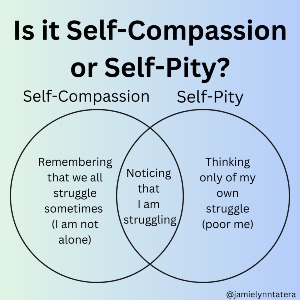
Self-Compassion or Self-Pity chart

Applying Self-Compassion to Our Parenting/Caregiving

The ultimate goal of my work is to help caregivers help children grow self-compassion. That being said, we can’t give away what we haven’t got. So we’ve got to begin by helping ourselves grow self-compassion.

Let’s face it, being a parent can be hard! When we have kids with extra struggles (physically, emotionally, or socially) the task can be even harder. So just how do we help ourselves experience connection and self-compassion in the midst of struggles?

A Personal Example

My children have been going through an arguing phase where they argue more than normal. This is stressful for me as a parent, and I feel empathy for the sadness and stress that their arguments cause one another.

The other day I was pondering their relationship on a walk. Because my daughters typically have a strong connection and have years of practice seeing one other’s perspectives, there’s nothing that I need to “do” to help to resolve the situation. Instead I reminded myself that all siblings go through phases of having more and less conflict. This is hard, but I am not alone in this experience, and it’s not my fault.

Growing Self-Compassion Together

It’s easier to grow self-compassionate connection when we are together in community experiencing the commonality of our struggles in real time. One of my hopes for this “Substack” newsletter is that we can connect with one another in both our common parenting struggles as well as our resilience-boosting “successes.”

I would love it if you shared your comments or questions by clicking on the comment button, and I also have plans to create a Q & A thread for my newsletter so we can learn and grow together.

And of course there’s an opportunity to grow self-compassion in community with others through taking one of my resilience-boosting classes: Parent-Child Self-Compassion, Resilient Parenting, or the adult Mindful Self-Compassion training (all three begin in January!).

Thank you for being a part of our community.

Wishing you light and love,

Jamie Lynn

5 Keys to Resilient Parenting

What emotional and psychological gifts do you wish for children? Perseverance, happiness, kindness, authenticity, compassion, joy? What about resilience? Resilience can be defined as the ability to endure or bounce back from difficulties. Sometimes people define resilience as “toughness,” but true resilience is not impenetrable. In fact, the kind of resilience I am talking about includes compassion and joy.

But just how do we cultivate resilience in children? The answer, of course, begins by cultivating resilience in ourselves. Below I’ve listed five keys to parenting with resilience as well as an example of how each of these keys helped me address an important parenting challenge – my child’s learning disability.

Rainbow

The 5 Keys:

1. Acceptance*  – Types of acceptance include self-acceptance, acceptance of your child and/or family, and acceptance of your life circumstances.

  • Accepting ourselves, our children and others lays a foundation for unconditional love. If you haven’t yet watched my kiwi bird video, it is a great metaphor for learning to accept ourselves and others as we are.
  • Accepting our lives as they are enables us to show up fully, with less resistance and stress.

I do not advocate for acceptance as a form of passive resignation when circumstances are non-optimal. Instead tender acceptance can provide a firm foundation for sustainable growth and change. When my older daughter was having learning difficulties at school, I had to acknowledge her challenge before I could figure out what to do about it. Acceptance allowed me to see that her divergent brain was not a match for mainstream school culture.

*Some people find the word acceptance unpalatable. If so, feel free to substitute the word “acknowledgment,” which is a precursor on the journey to acceptance.


2. Growth – We can complement (self-) acceptance with a desire to grow and change. Sustainable growth and change requires humility. Humility does not mean thinking we are less than others. Quite to the contrary, humility means recognizing that we are on the learning team, just like every other human. It gives us the courage to see that we and our kids have both strengths and weaknesses. Self-compassionate humility can buffer us from defensive and resilience-robbing responses to failure and shame.

Humility allowed me to view both the strengths and weaknesses that accompanied my daughter’s learning differences. The non-linear nature of her thinking was an asset to her creative process, but it was a liability when she was asked to read a block of text or present ideas in a linear sequence. Seeing her divergent brain through a lens of humility allowed me to hold the challenges and gifts side-by-side.

Seeing ourselves and our children as imperfect and beautiful human beings allows us to clearly see the ways that we need to grow and change. This desire to change is stimulated not from a sense of shame or inadequacy, but rather because we love ourselves enough to want what is best for us.


3. Curiosity – What do you do when you and/or your child has a problem that you don’t know how to solve? How do you respond when things are not okay, but you’re not sure where to turn? When panic, confusion, and overwhelm threaten to highjack your brain, curiosity is your ally. Consider the powerful shift curiosity can create: “I wonder how I should respond? I wonder how other parents have addressed problems like this? I wonder who might know more about this kind of thing?” Thinking that there is only one “right way” to solve a problem (and that we are a failure if we can’t find it) is resilience depleting. Wondering about causes, conditions, resources, and potential pathways opens the mind to new possibilities.

I remember well the angst of not knowing how to help my daughter learn to read and process decontextualized academic information. I read books on the topic, talked to professionals and friends, and became curious about how to create a bridge between her way of learning and the school environment. We ended up changing schools, enlisting school support, and hiring outside tutors. It was a long and messy process requiring many of the keys of resilient parenting, including the next one – compassion.


4. Compassion  Stuff happens! Life will go wrong. We and our kids will have problems. Compassion means holding ourselves and others with kindness when we are struggling, and seeking to alleviate suffering whenever possible. Some might think that compassion is the way of weakness; paradoxically it is the main taproot of resilience. If I had to choose only one of the five keys of resilience, it would be compassion. In its tender form, compassion can hold us in our struggles (acceptance), and its strong form it can help us to create positive growth and change. Visit jamielynntatera.com if you’d like to learn more about cultivating compassion and self-compassion in children and families.

Our family needed fierce compassion to find the diagnoses and resources that my older daughter needed for academic success as well as tender (self-) compasion to hold us as she struggled with learning challenges.


5. Soaking in the Good – While struggle is a part of life, so too is beauty. Our negativity bias encourages us to orient toward difficulties, but sustaining resilience requires that we also take in the beautiful moments.

Sometimes we might be afraid to take in the good because good moments can be fleeting. While it’s true that many good things don’t last, it’s precisely because of this that we need to open to their goodness. We are invited to soak in the goodness of our children, ourselves, and our lives as fully as possible so that when the moment passes we retain traces of its goodness. Internalized goodness will make us more resilient when the inevitable challenges of life arise.

The early days of my older daughter’s learning challenges were emotionally draining for her and our family. We had to intentionally remember to focus on her gifts and the places outside of school where she experienced success and joy. After years of interventions, my older daughter now experiences moments of scuccess within the school environment. This past year we were all able to celebrate when she achieved her first report card with straight A’s. Her learning challenges are not over, but we are learning to navigate them with the keys of resilience, including soaking in the good.

___________________________

When you see this list of five keys to resilience, you might think, “I haven’t mastered those things yet!” Not to worry, you are not alone. The keys are “north stars” on the journey rather than destinations that we can achieve.

If you are cultivating humility (our second key), you will remember that it is essential to be on the learning team. Curiosity (key number three) can help you to discover the next step on your journey. Acceptance and compassion (our first and fourth keys) will be your companions when you inevitably fall short. And when you have those moments that you actually hit the mark, be sure to take in the good (key #5)!

Feel free to reach out to me as you stumble along this brutiful journey of living and loving with resilience.


Your companion on the journey,
Jamie Lynn

Six Ways I Fall Short as a Parent (and how self-compassion helps)

Have you ever experienced “imposter syndrome”? Imposter syndrome is when you think that you are not “good enough” to share on a topic or do a particular task because you are imperfect, and your brain tells you the story that your imperfection and doubts make you inadequate, unworthy, a fraud, etc. Interestingly enough, when I consider sharing with parents strategies for helping kids become self-compassionate, I sometimes experience imposter syndrome. I think, “Who am I to share about parenting when I so often fall short?”

It’s true. I do fall short as a parent. And it’s also true that self-compassion helps. We will all fall short in any endeavor that is important to us. What is important to remember is that our imperfections do not negate our strengths, nor do they make us unable to do the important work that we have been called to do in the world.

Even a photo can trigger imposter syndrome in me. Somedays my daughters and I comb our hair and smile…other days, not so much 😉

As I gather courage to share tips for parents, I will challenge my imposter syndrome by sharing 6 ways that I fall short as a parent and six ways that self-compassion makes me strong.

Here’s a list of my parenting shortcomings (not exhaustive, and not even necessarily the most glaring offenders):
1) I sometimes struggle with housework. Ummm… really. We are talking about inside out underwear…which can actually be a great strategy when you are behind on laundry.
2) I am addicted to audio books. I have earbuds in my ears while listening to audiobooks a lot!
3) I can get impatient when my kids interrupt me. My brain tends to be mono-focused, and I don’t shift easily.
4) I have a really hard time listening when my kids talk about things that I consider to be trivial. Small talk in general is a growth edge for me.
5) I work too much (but I love my work, and it helps children!!)
6) I can get easily overwhelmed when life gets busy.

I’m giving myself compassion for numbers five and six, and even one through four. Self-compassion doesn’t mean that we pretend that our weaknesses are “fine” or that we don’t strive to grow and change. Self-compassion means that we meet ourselves with kindness and recognize that we, just like others, are imperfect human beings. Self-compassion both helps me try to grow and change, and also recognize that I’m still loveable when I fall short.

In addition to my weaknesses, I have strengths as a parent. Here are a few of my parenting strengths:
1) I usually show up well for my kids when they are upset.
2) I have awesome strategies for helping kids integrate difficult emotions.
3) I know how to say, “this is too much. I need help.” I can find affordable and/or creative solutions for parenting or household tasks that I find overwhelming (including my housework!!).
4) I let my kids know that I, too, am on the learning team.
5) I am very creative, and I have awesome, creative strategies for helping parents and kids grow mindfulness and self-compassion.
6) And I’m pretty good at loving myself and the other imperfect beings who live in my house.

Please know that when I share tips about how we can help our kids (and ourselves!) when we are struggling, I’m sharing them as a fellow struggling human – with strengths and weaknesses…just like you.

Thanks for accompanying me as we collectively learn to grow, stumble, and love together.

With love,
Jamie Lynn

The Healing Power of Yoga

Have you ever been stuck in a difficult mind loop and unsure how how to get unstuck? Me, too! When a difficult situation or emotion has me spinning, it means that my amygdala has been activated and my prefrontal cortex will be of limited help. What does this mean in lay people’s terms? It means that I need to get out of my own head.

So just how do we do that? I have two favorite strategies. The first is to call a friend and the second is to move my body.

Calling a friend is honestly my easiest and quickest go-to strategy. It’s a great way to “name” my emotions and thought patterns and simultaneously receive compassionate support from another. But what if my friend is unavailabe, or I’ve already called and I’m still spinning? I move my body.

Big movement, especially outdoors, can do wonders for a mind that is beleaguered by stressful thoughts. But big movment is not always accessible-especially if it’s late at night. When my mind is churning, and I’m indoors, I turn to mindful and self-compassionate yoga.

Sometimes I listen to a guided yoga practice, like Mindful Yoga from the MBSR course. Other times I do yoga on my own (see my own guided Mindful Yoga practice below).

Yoga can be a game-changer because it gets me out of my head into my body. Sometimes a situation is too much for my mind to take in on its own, but my body can do the heavy lifting of metabolizing the emotions. When we can calm and center the body, it can calm and center the mind.